



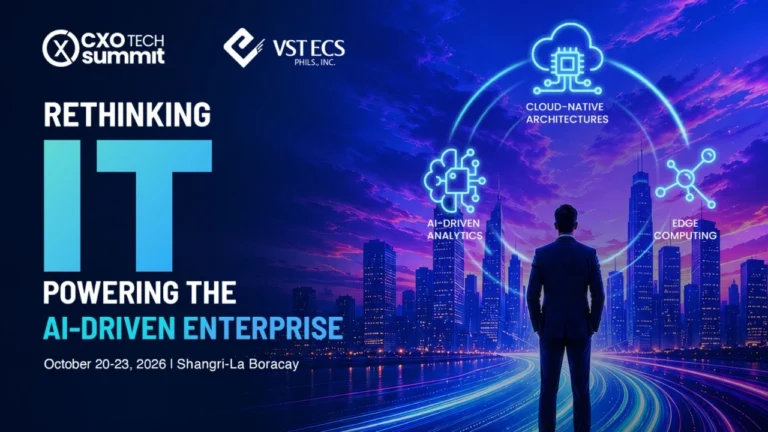
The country’s senior technology leadership convened this week at Shangri-La Boracay for the 9th Annual VST ECS CXO Tech Summit 2026, shifting the conversation around enterprise artificial intelligence from speculative experimentation to operational deployment. Organized by VST ECS Phils., Inc., the country’s largest ICT distributor, the four-day, invitation-only conference runs from October 20 to 23 under the theme “Rethinking IT: Powering the AI-Driven Enterprise.” The delegation brings together Chief Information Officers, Chief Technology Officers, Chief Information Security Officers, and enterprise IT directors representing the Philippines’ major banking, healthcare, retail, manufacturing, telecommunications, energy, BPO, and public sector institutions.
The Reality Check: Moving Beyond the Pilot Stage
Opening the summit, VST ECS Phils., Inc. President and CEO Jimmy Go laid out the central dilemma facing IT decision-makers: bridging the gap between isolated AI proofs of concept and production workflows that show up on the bottom line. Go emphasized that early-adopter enterprises have already embedded AI into day-to-day operations across credit scoring, customer service, demand forecasting, document processing, and internal software development.
“Two years ago, AI was a demo. Last year, it was a pilot. This year, the leaders who are pulling ahead have moved it into production. Technology is no longer a department. Technology is now the business itself,” Go said.
Addressing the macro-environment, Go highlighted that Philippine organizations are executing these digital roadmaps against mounting external headwinds. A global supply squeeze on high-performance memory and enterprise storage—driven directly by AI compute demand—has driven up infrastructure costs and forced several planned deployments into 2027.
On the domestic front, regulatory compliance has tightened significantly under Executive Order 119, which mandates stricter data residency and sovereignty requirements for sensitive workloads. Go framed these constraints alongside ongoing expansions in domestic cloud and hyperscale data center capacity, arguing that Philippine human capital remains the country’s primary competitive edge.
“We have one of the most digitally active, English-proficient, service-minded workforces in the world. AI will not replace that talent. But talent that uses AI will replace talent that does not. Our job as leaders is to make sure our people are on the right side of that line,” Go noted.
CXO Tech Summit 2026 Pragmatic Breakouts: Security, Infrastructure, Data, and Cost
Rather than relying purely on high-level keynote speeches, the summit program structures 24 simultaneous breakout sessions across four dedicated tracks, designed to give delegates technical access to solution architects and vendor specialists:
- Securing AI and the Enterprise: Focused on automating security operations centers (SOC), implementing zero-trust architectures, DNS-level threat detection, and treating API security as a core governance issue. Sessions feature technical partners including Fortinet, Stellar Cyber, Akamai, iboss, EfficientIP, and Versa Networks.
- Building AI-Ready Infrastructure: Covering modern campus network models, edge AI deployments, data center architecture, and hardware provisioning for AI token processing, led by Huawei, APC by Schneider Electric, H3C, Arista Networks, Samsung B2B, ASUS, and Nutanix.
- Getting the Data Foundation Right: Addressing why early AI pilots stall before reaching production, emphasizing data resilience and hygiene strategies alongside specialists from YugabyteDB, Seagate, NetApp, Rubrik, and Cloudera.
- The Economics and Impact of Running AI: Analyzing total cost of ownership (TCO), workplace productivity metrics, and day-to-day operational integration with HPE, Cisco, Oracle, Dell Technologies, HP, and Hexnode.
CXO Tech Summit 2026 – Plenaries, Peer Realities, and Floor Demos
Main-stage plenary sessions in the Sagana Ballroom focus on running agentic AI workflows at scale, transitioning from AI-ready to AI-native system architectures, managing hybrid and multi-cloud environments, and navigating governance and commercially safe generative AI models. Participating plenary partners include AWS, broad infrastructure and silicon vendors such as Dell Technologies, Cisco, Lenovo, HPE, Nutanix, HP and AMD, along with Broadcom (VMware), Adobe, Autodesk, Fastly, Synology, TrendAI, and Archer.
To balance vendor roadmaps with real-world operational trade-offs, the summit features dedicated fireside chats across cybersecurity, infrastructure, and live AI use cases, alongside an industry CIO panel. Technology leaders from BDO Unibank, Energy Development Corporation, St. Luke’s Medical Center, Enshored, Monde Nissin, Miriam College, and K-Logistikus shared operational post-mortems—detailing implementation hurdles, legacy friction, and key lessons learned across their respective sectors.
Beyond the conference halls, the event hosts 52 partner exhibition booths demonstrating live hardware and software implementations, with proceedings summarized daily in the summit’s digital CXO Magazine.

Grant Soriano
Grant is a Financial Management graduate from UST. His passion for gadgets and tech crossed him over in the industry where he could apply his knowledge as an enthusiast and in-depth analytic skills as a Finance Major. His passion allows him to earn at the same time help Gadget Pilipinas' readers in making smart, value-based decisions and purchases with his reviews and guides.
View all articles →