


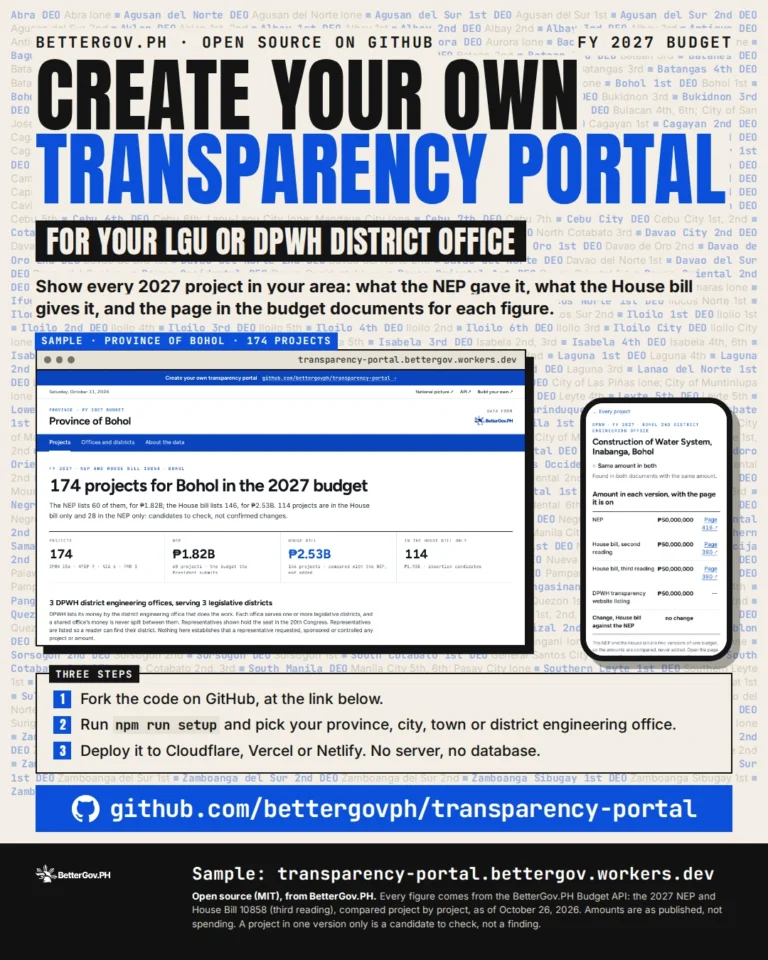
BetterGov.PH has opened an invitation to developers, civic tech advocates, LGU IT teams and newsrooms: build your own transparency portal for a province, city, municipality or DPWH district engineering office, using the same data engine that powers its national budget site.
The portal lists every 2027 project in the budget and sets the original National Expenditure Program against the House Bill allocations. It shows what was added, what was dropped, and the exact page of the source document for every figure. The code is free, open source, and published under the MIT license.
No servers, no database, no hosting bill
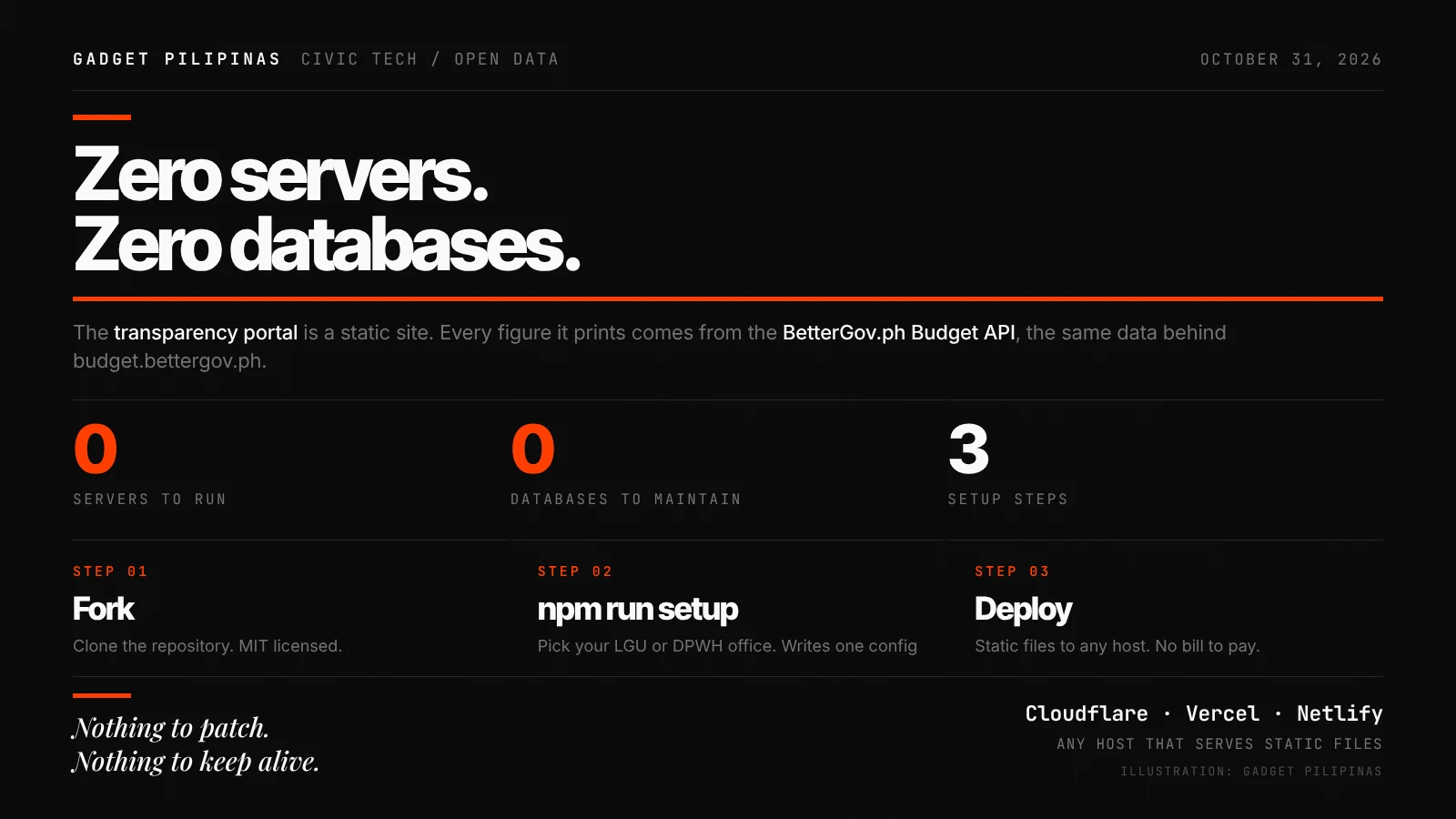
The design choice that makes this practical is that there is nothing to run. The transparency portal has no backend and no database. Every number comes from the public BetterGov.ph Budget API, which is the same data behind budget.bettergov.ph. That means a fork produces a static site that can be hosted anywhere without a monthly bill or a server to patch.
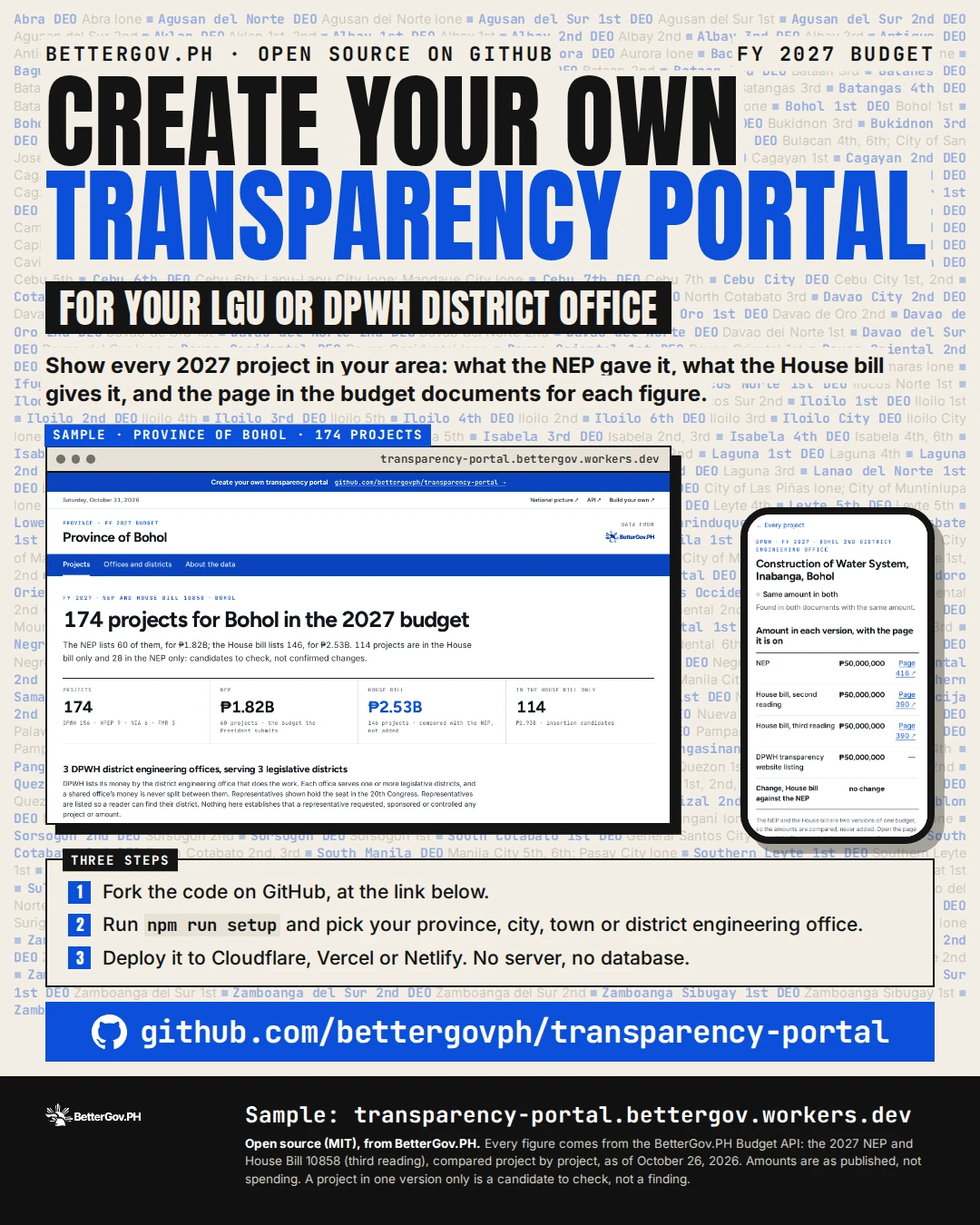
BetterGov.PH puts the setup at three steps: fork the code, run npm run setup and pick the target LGU or district engineering office, then deploy. The repository ships ready-made configuration for Cloudflare Workers, Vercel and Netlify, and any host that can serve static files will work if unknown paths are pointed at index.html.
Everything a fork needs to change lives in a single file, portal.config.ts, which the setup script writes for you after looking up the exact names and IDs in the API.
What a transparency portal actually shows
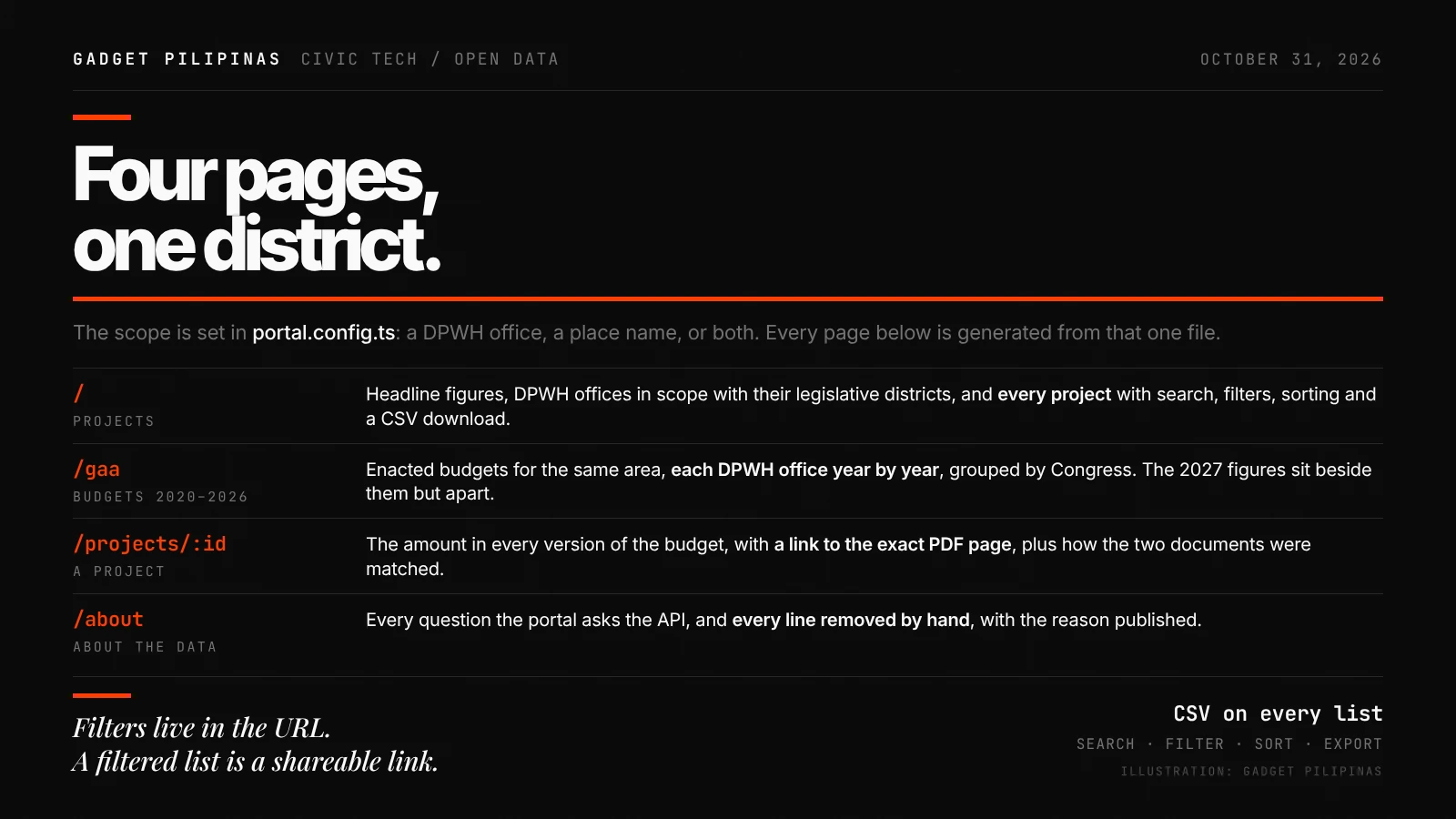
The site has four pages, and the scope is chosen in the config. A DPWH office option brings in that office’s entire ledger, which is what a district engineering office portal would use. A place name option searches the titles of all four covered programs, catching projects under the DPWH Central Office and work that has no office attached.
The Projects page carries the headline figures, the DPWH offices in scope with their 2027 numbers, the legislative districts those offices serve along with their representatives, and every project with search, filters, sorting and a CSV download. Filters are stored in the URL, so a filtered list can be shared as a link.
A second page covers the enacted budgets from 2020 to 2026 for the same area, showing each DPWH office’s budget year by year grouped by Congress, with the 2027 figures beside them but kept separate. Individual project pages show the amount in every version with a link to the exact PDF page, how the two documents were matched, and why the line is in that portal at all. An About page publishes every question the portal asks the API, every line removed by hand and the reason for it.
The caution is built into the product
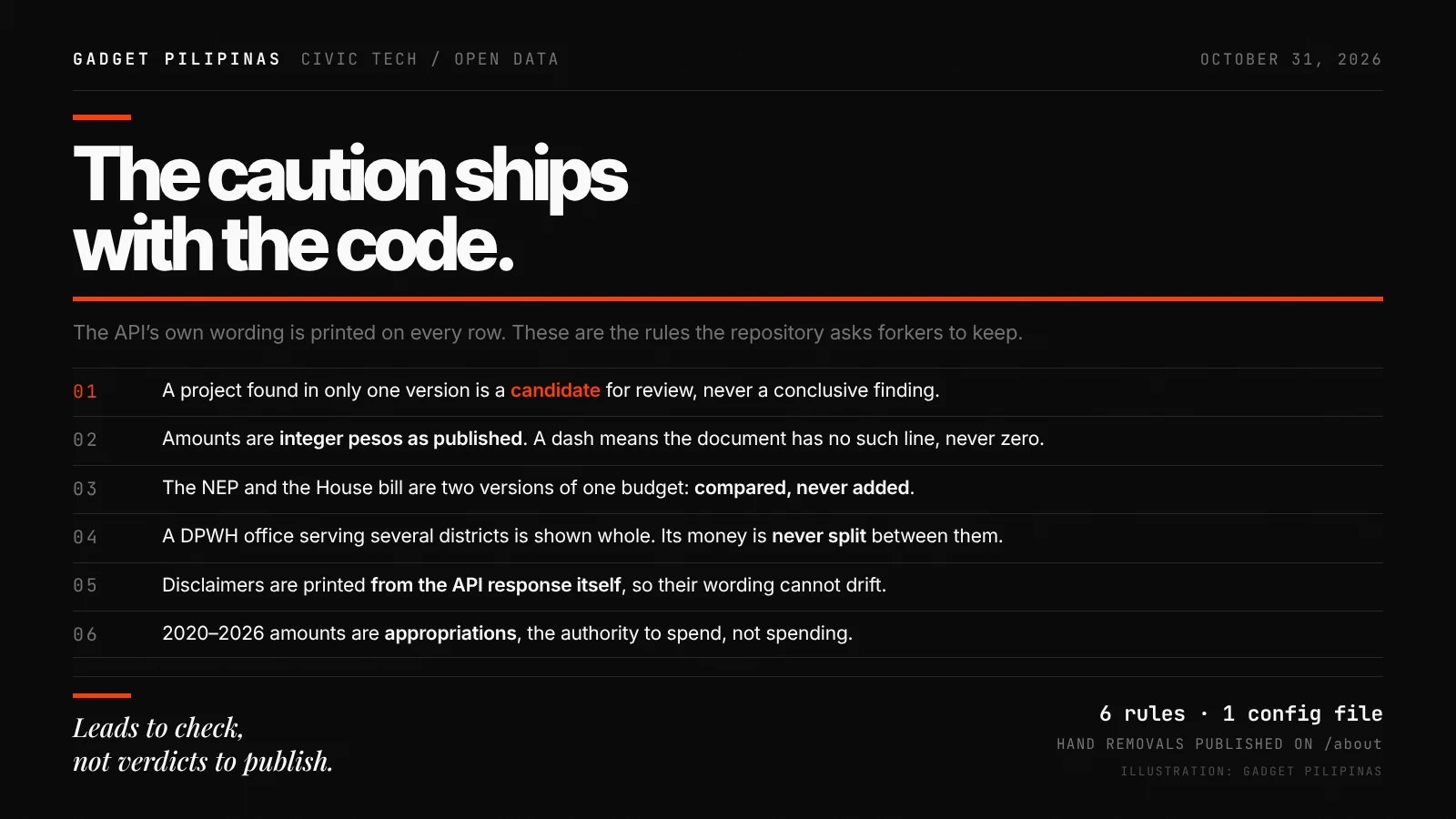
The caveats are not buried in a footnote, and this is the part that distinguishes the project from a scoreboard. The API’s wording states that a project found in only one version of the budget is a candidate for further review, not a conclusive finding. The portal repeats that on every row and prints its disclaimers directly from the API response, so the wording cannot drift out of sync with the national site.
The rules the repo asks forkers to keep are equally specific. Amounts are integer pesos as published, and a dash means the document has no such line rather than zero. The NEP and the House bill are two versions of one budget, so they are compared and never added together. A DPWH office that serves several districts is shown whole, with its money never split between them. Enacted amounts for 2020 to 2026 are appropriations, meaning authority to spend rather than spending itself.
What it cannot do yet
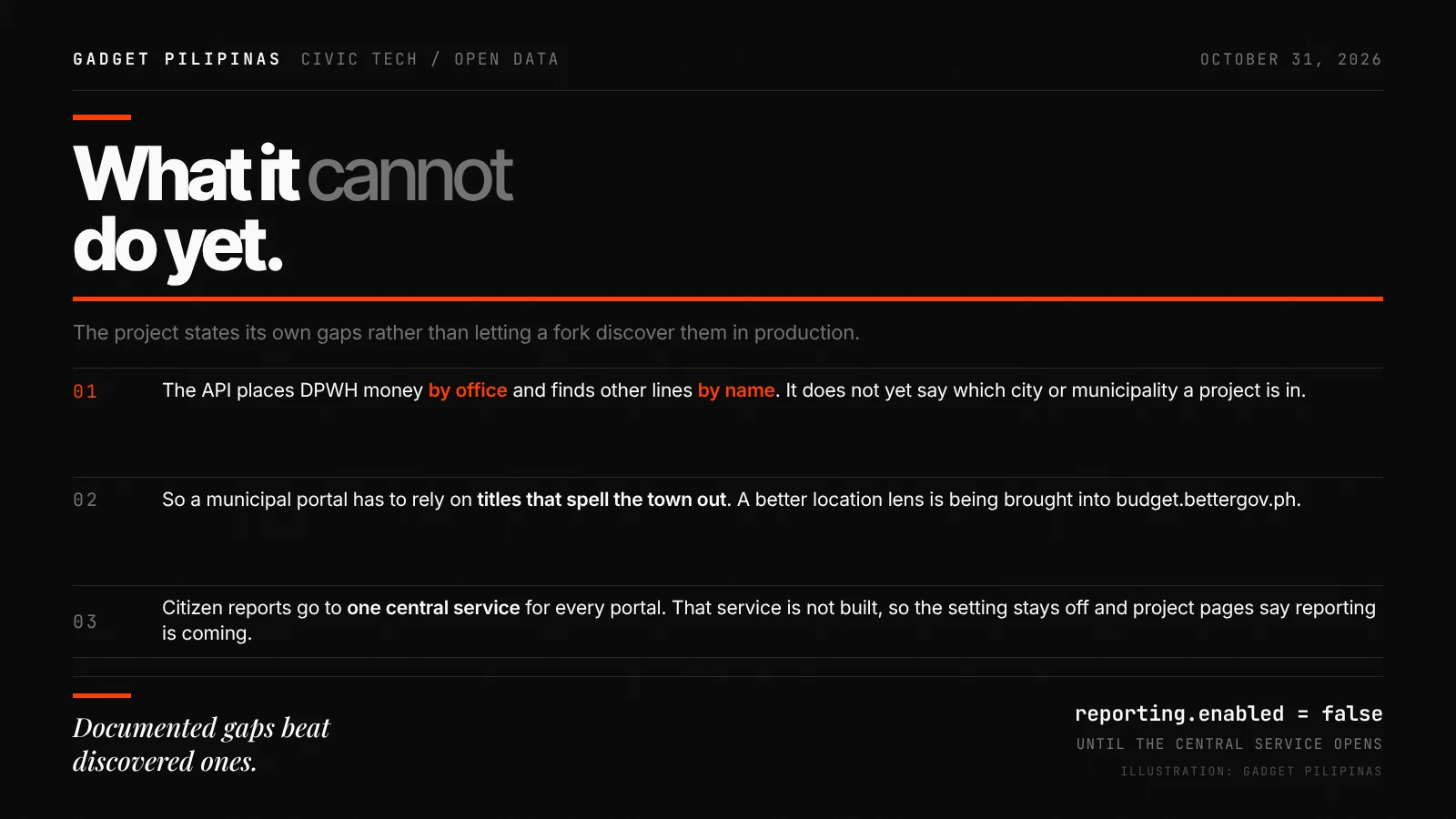
BetterGov.PH is upfront about the limitation. The API places DPWH money by office and finds other lines by name. It does not yet say which city or municipality a given project sits in, so a municipal portal has to rely on titles that spell the town out. A location lens that places lines by the place named in their title is being brought into budget.bettergov.ph, and once the API serves it, a municipality scope can use it directly.
Citizen reporting is also staged rather than shipped. Reports about a project will go to one central service for every portal, and that service is not built. Until it opens, the setting stays disabled and project pages say reporting is coming.
Why this matters beyond one website
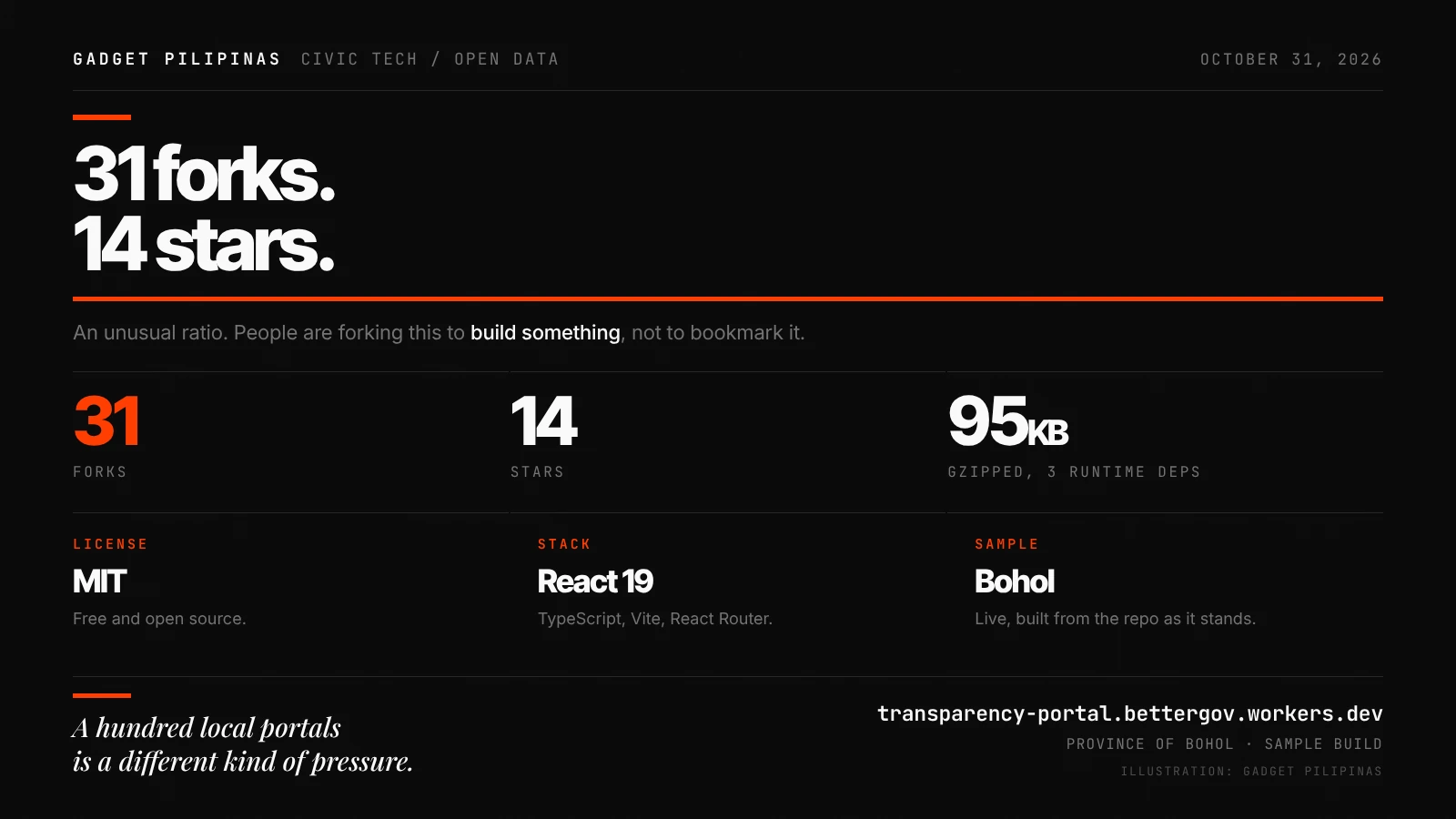
A national budget tracker is useful. A hundred local ones, each a transparency portal for a single district with a page reference behind every number, is a different kind of pressure. The person who can check whether a road in their own municipality survived the House version does not need to trust a national dashboard or a press release.
The repository’s own numbers suggest people are already trying. It has 31 forks against 14 stars, an unusual ratio that points to people forking it to build something rather than simply bookmarking it. A live sample for the Province of Bohol is running at transparency-portal.bettergov.workers.dev, built from the repository as it stands.
The stack is deliberately ordinary: React 19, TypeScript, Vite and React Router, the same as budget.bettergov.ph and using its type and color system. Three runtime dependencies and about 95 KB gzipped.
We covered BetterGov.PH’s national insertion tracker and how it answered a lawmaker who called its critics ignorant. This is the same data, handed out in a form that a provincial IT officer or a student newsroom can actually deploy.

Gadget Pilipinas
Founded in 2009 by Gian Viterbo, Gadget Pilipinas is one of Philippines’ top sources for news, tutorials, reviews and tips about the latest trends in technology, gadgets, games, social and digital media and cyber culture.
View all articles →