

The DICT Adobe contract is 97 pages long and contains exactly one number that matters to a taxpayer: PhP3,342,500. It does not contain the number that would let you judge it. How much is that per person?
So we did the division ourselves. PhP3,342,500 for 35 user accounts over 12 months comes to PhP95,500 per seat per year. We then went looking for the answer to the only question that follows: is that fair?
What DICT actually bought
The project is called the “Procurement of Subscription to Graphic Design Platform Package for One (1) Year,” bid reference DICTBAC-2026-059, published by the Department of Information and Communications Technology. For readers who do not live inside procurement documents: DICT is the national agency in charge of information and communications technology policy, and procurement is simply the government’s word for buying things. In plain terms, DICT is renting 35 licences of professional creative software for a year, the kind used to build layouts, illustrations, photographs, and video for government communications.
The document never names a brand. It does not have to. The specifications list file formats (Psdt, Ait, indt, FLA, XFL, OAM), one terabyte of cloud storage per user, and at least 6,000 generative AI credits per licence. Taken together, those describe one product: Adobe Creative Cloud. No other creative suite on the market matches all three.
So how fair is the DICT Adobe contract?
Here the honest answer is more reassuring than we expected. We pulled what other Philippine government agencies paid for the same software. Two terms explain the figures that follow. ABC, or Approved Budget for the Contract, is the ceiling an agency is legally allowed to spend, not the price it agreed to. The awarded amount is what a contract actually closed at after bidding.
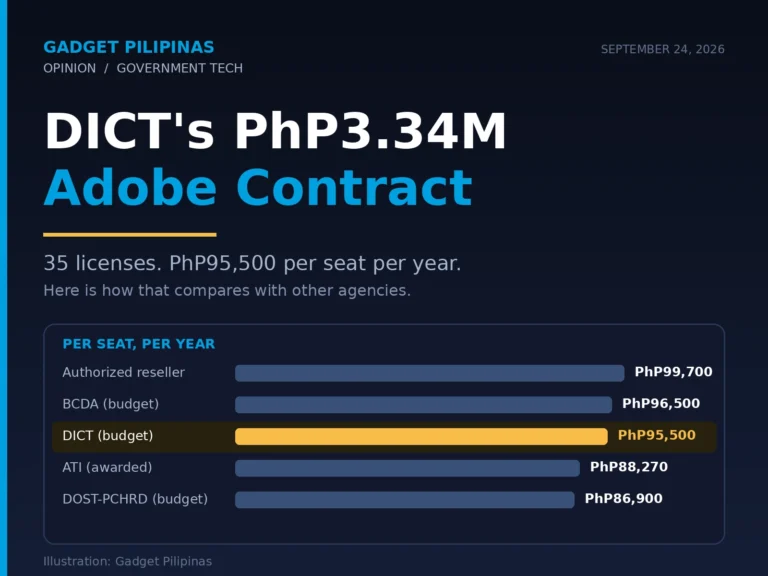
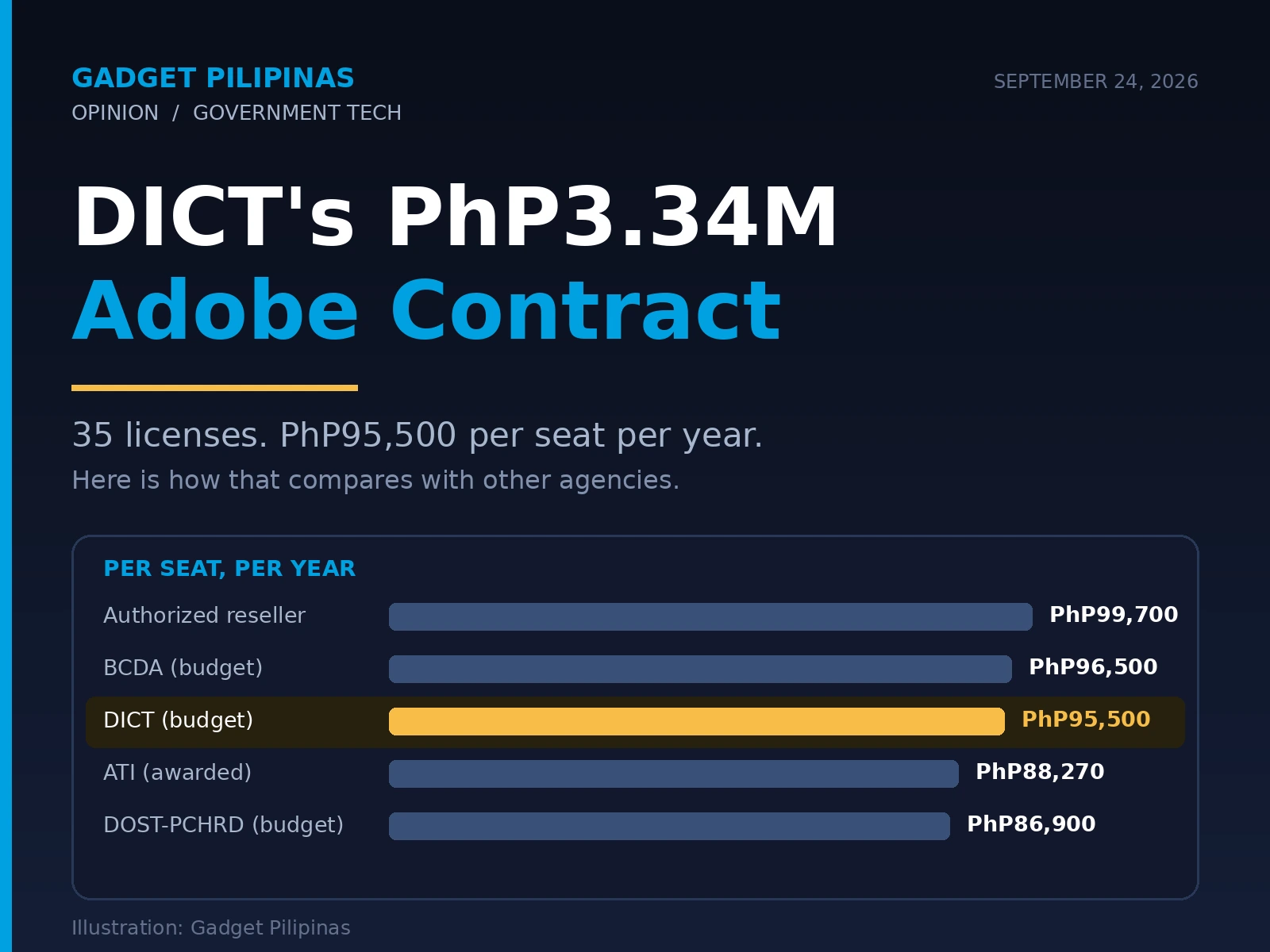
- Agricultural Training Institute (ATI, under the Department of Agriculture), bidding reference ITB-ATI-CO-2026-14, 22 licences of Adobe Creative Cloud Pro Plus for Teams in the Enterprise/VIP segment, awarded on 23 July 2026 to Commerce First, Inc. for PhP1,941,940. That is PhP88,270 per seat per year, down from a ceiling of PhP96,000.
- Bases Conversion and Development Authority (BCDA), 9 licences of Adobe Creative Cloud All Apps covering April 2026 to April 2027, approved budget PhP868,500. That is PhP96,500 per seat.
- DOST Philippine Council for Health Research and Development (PCHRD), 2 licences of Adobe Creative Cloud, approved budget PhP173,800. That is PhP86,900 per seat.
- DICT, 35 licences, approved budget PhP3,342,500. That is PhP95,500 per seat.
- A local authorised reseller lists the same class of product, one user for 12 months, at PhP99,700.
The ATI comparison is the one that matters most, because it is the closest match available. ATI bought the same product family, the same storage allowance of one terabyte per user, the same one-on-one access to Adobe product experts, and the same requirement that the supplier be an authorised Adobe reseller. It bought 22 seats. DICT has budgeted for 35. ATI’s bid was evaluated in July 2026, one month before DICT’s was published in August.
Set DICT’s PhP95,500 against that. It is PhP500 per seat below ATI’s approved ceiling for the same product in the same segment a month earlier. It is inside a band running from PhP86,900 to PhP99,700. It is not the cheapest, and it is not an outlier. On the evidence available, the price is defensible.
Is it at par with Adobe Philippines pricing?
This is where the answer gets interesting, because Adobe does not publish it.
Adobe’s Philippine business pages do not display a business price at all. They render placeholder text where a figure should appear and direct companies to contact a reseller. Consumer pricing is public and irrelevant here, because it is a different product sold to a different buyer under different terms.
So there is no published Adobe Philippines standard for a 35-seat business licence that an agency, a journalist, or a citizen can simply look up. The only workable test is what Adobe’s authorised resellers and other government agencies actually charge. By that test, DICT is at par.
Why this matters beyond DICT
DICT is not just another buyer. It is the government’s information and communications technology authority, the agency expected to know what technology costs and to set the standard other offices follow. We have covered how far that authority reaches before, including the order for Reddit and Discord to set up local offices in the Philippines. When DICT commits PhP3.34 million to software, that figure becomes a reference point.
It is also a recurring cost, not a one-off. The same procurement ran in 2025 with an approved budget of PhP3,150,000, or PhP90,000 per seat. This year’s PhP95,500 is a 6.1 percent increase. Small differences in a per-seat rate repeat every year, and across every agency that copies the template.
And it is the kind of spending that is easy to overlook precisely because it is ordinary. Nobody holds a ribbon cutting for a software subscription.
The ceiling is not the price
One comparison deserves a closer look, and it is the most useful thing in this entire piece.
ATI did not pay its ceiling. It budgeted PhP2,112,000 and signed at PhP1,941,940. Competitive bidding took 8.1 percent off the top.
The DICT Adobe contract is budgeted at a ceiling too. If its bidding proves as competitive as ATI’s, the contract should land near PhP3.09 million, roughly PhP250,000 below the approved budget. If it lands at or very near the ceiling instead, that is not automatically wrongdoing, but it is a question worth putting on the record.
There is a second pattern in those numbers. The per-seat rate barely moves with volume. PCHRD paid about PhP86,900 per seat for two licences. ATI paid PhP88,270 for twenty-two. BCDA budgeted PhP96,500 for nine. A 35-seat buyer might reasonably expect the best rate of the group and is not, on the current budget, in line to get it. That is worth asking about, and the answer may simply be that Adobe prices these licences in tiers rather than by volume.
The bidding document also carries drafting problems that suggest it was assembled quickly. It states the penalty for late delivery twice, with two different numbers, one of them off by a factor of 100. It sets the required project experience at two years in one section and ten in another. It cross-references a licence agreement that is not part of the document. None of this proves anything improper. All of it hands extra discretion to the BAC, the Bids and Awards Committee that evaluates the offers, and all of it is worth correcting before the next round.
Why we are asking
Because none of the above would exist without the asking.
Every figure in this piece came from documents that are already public. The bidding papers are posted online. Purchase orders and notices of award are published through PhilGEPS, the Philippine Government Electronic Procurement System, and on agency websites. The Government Procurement Policy Board sets the rules, the Commission on Audit reviews the spending, and Republic Act 12009, the law that now governs this contract, exists to make government buying checkable rather than secret.
What is missing is not access. It is attention. Somebody has to open the file, notice the number that was left out, and go looking for a comparison. That is the same civic muscle behind tools like the BetterGov.ph political dynasty tracker, which turns public records nobody reads into something anyone can check.
Doing that work is not an accusation. It is the ordinary maintenance of public trust, and the strongest argument for it is what happened here. We asked, and the answer came back largely clean. The price holds up.
That is a good outcome. It is also the only kind of outcome you can get if you ask.
Sources and documents
- DICT, Bidding Document, “Procurement of Subscription to Graphic Design Platform Package for One (1) Year” (DICTBAC-2026-059): cms-cdn.e.gov.ph
- Department of Agriculture, Agricultural Training Institute, Bidding Documents ITB-ATI-CO-2026-14, “Renewal of Subscription of Adobe Creative Cloud Pro Plus for Teams Accounts”: ati2.da.gov.ph
- ATI, Notice of Award, Subscription of Adobe Creative Cloud Pro Plus for Team Accounts: ati2.da.gov.ph
- Bases Conversion and Development Authority, procurement of Adobe subscription and maintenance: bcda.gov.ph
- DOST-PCHRD, Request for Quotation, Adobe Creative Cloud licence renewal: pchrd.dost.gov.ph
- Office of the President, Notice of Award, Adobe Creative Cloud for Teams (PR No. 26-04-0782): op-proper.gov.ph
- Authorised reseller listing, Adobe Creative Cloud for business: benson.ph
- Adobe, Creative Cloud for business and teams: adobe.com
- Government Procurement Policy Board: gppb.gov.ph
- Philippine Government Electronic Procurement System: philgeps.gov.ph

Giancarlo Viterbo
Giancarlo Viterbo is a Filipino Technology Journalist, blogger and Editor of gadgetpilipinas.net, He is also a Geek, Dad and a Husband. He knows a lot about washing the dishes, doing some errands and following instructions from his boss on his day job. Follow him on twitter: @gianviterbo and @gadgetpilipinas.
View all articles →Related News
 GIGABYTE AORUS RTX 5060 ARI Edition Now Available