










Every Filipino voter has run into the same wall: the record of who has held office in their town, district and province exists, but it sits scattered across decades of COMELEC files, and nobody has the time to assemble it before election day. A rebuilt political dynasty tracker from BetterGov.ph puts that record in one free page.
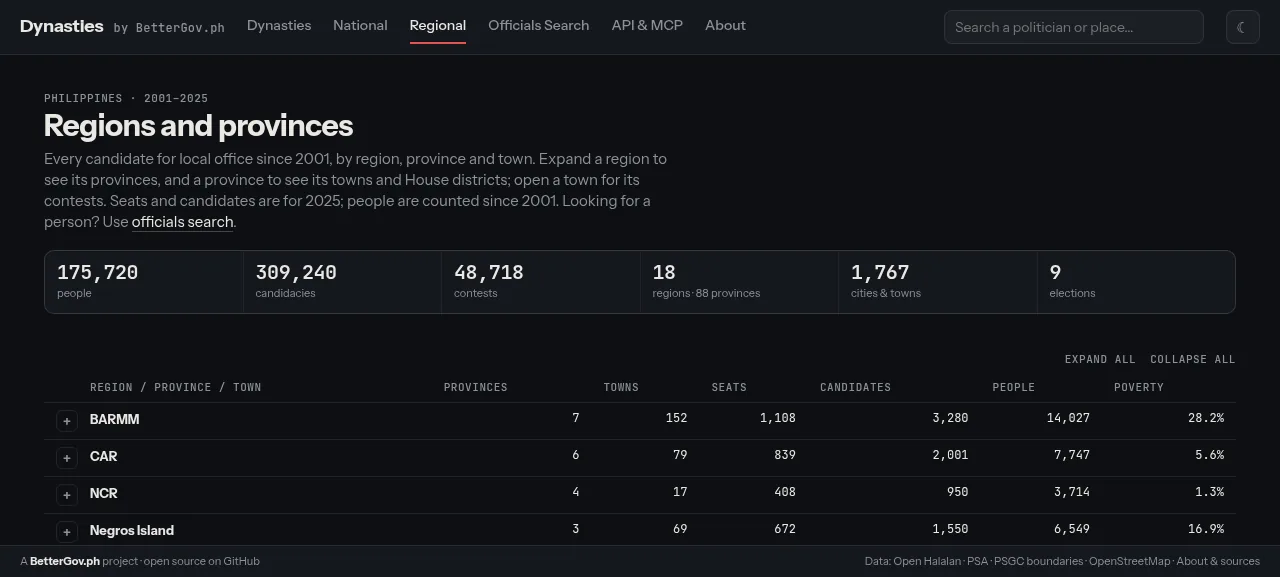
Dynasties, live at dynasties.bettergov.ph, covers 175,720 people, 309,240 candidacies and 48,718 contests across 88 provinces, 1,767 cities and towns, and nine elections from 2001 to 2025. BetterGov.ph is the volunteer civic tech group behind several open government data projects.
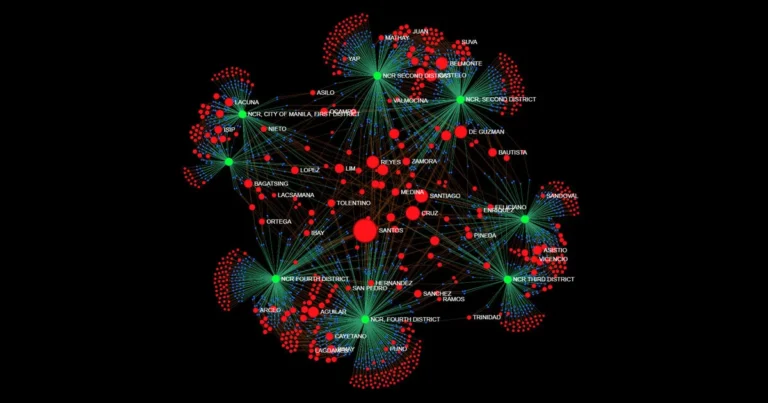
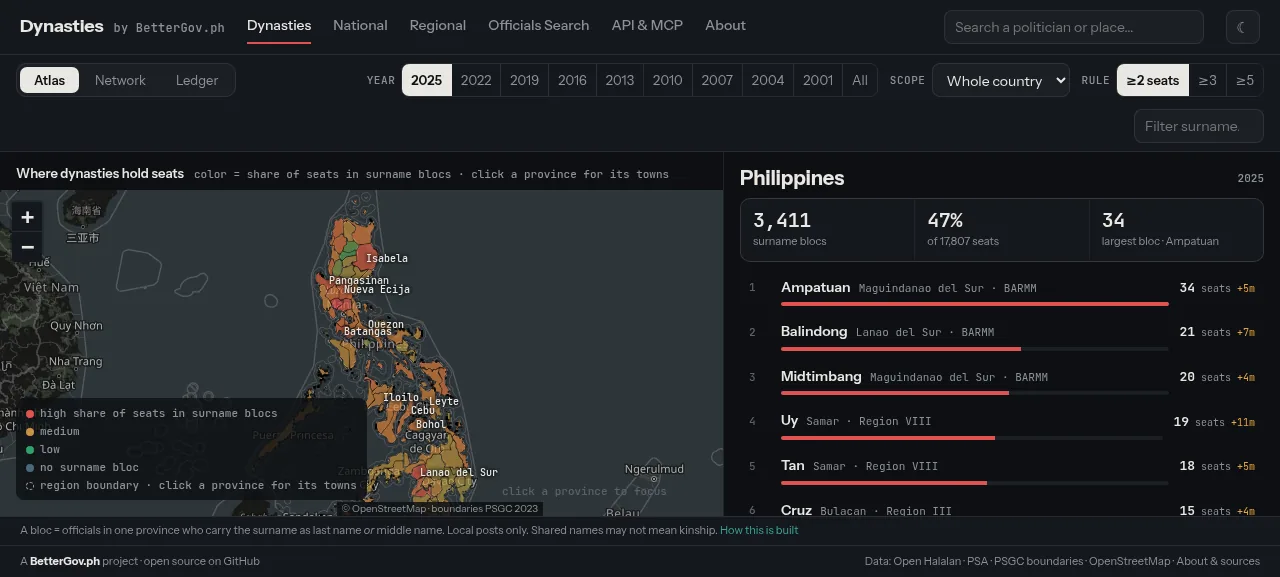
The site groups officials in a province who share a surname, as a last name or a middle name, into a “bloc”. A selector sets how many seats that name needs before it counts, at two, three or five, and the result can be read as an atlas of the country, as a network graph of surnames, or as a ledger. In the 2025 view alone, more than 3,400 surname blocs clear the two-seat rule, and the largest single bloc holds 34 seats in one province.
What Filipino voters can check for free
Dynasties needs no account and no payment. It answers questions that used to take a research assistant days.
- Regional lists every region, province and town with each contest, its candidates, votes, vote shares, margins and results.
- Officials Search holds one record per politician with their full election history. Of the 175,720 people in the file, 65,877 ran more than once, which turns the “same names every three years” feeling into a number.
- National covers presidential, vice presidential, Senate and party-list totals by province.
- Poverty incidence from the Philippine Statistics Authority sits in the same table as the bloc counts, so the argument over dynasties and poverty can be checked against figures instead of anecdotes.

The project is open data too. The site publishes a read-only JSON API under officials.bettergov.ph and a Model Context Protocol server at officials.bettergov.ph/mcp, with eight tools for officials, contests, surname blocs, national results, seat changes across elections and the coverage report. An AI assistant can now query two decades of local results directly, and developers can join election data to budgets, flood control projects and procurement records, the same way the volunteers behind it do in their other projects. The code is public at bettergovph/officials-network-graph, opened in July and last updated on September 16 with 71 commits.
Why the political dynasty tracker matters now
The launch lands in a busy election calendar. Unless a new law moves them, the Barangay and Sangguniang Kabataan Elections stay on November 2, 2026. The Senate passed Senate Bill 2387 on September 14 to shift the village and youth polls to the second Monday of November 2028 and extend terms from four to five years, the House adopted that version on September 16, and the measure is now with Malacañang. COMELEC chair George Erwin Garcia has said a decision is needed by September 28, when the filing of certificates of candidacy is due to start, and that the commission has spent PhP8 billion on preparations.
The national and local elections follow on May 8, 2028. Those are the races this dataset covers, at governor, vice governor, board member, mayor, vice mayor, councilor and House district level. Barangay posts are not in the file, so the barangay contests themselves stay a blind spot. Coverage of the last national exercise is in our quick guide to the 2025 midterms, and Google and YouTube ran election information features of their own for those polls.
Congress is working on the same subject. House Bill 8389, the proposed Anti-Political Dynasty Act, cleared the House on third reading in June with 267 votes in favor, 20 against and 7 abstentions, and now sits with the Senate. It bars spouses and relatives within the second degree of consanguinity or affinity from holding or seeking elective posts in the same jurisdiction, and would apply from the next elections once enacted. Article II, Section 26 of the 1987 Constitution has required that law since 1987, and there is still none.
That is the gap the data fills. If the ban takes effect in time for 2028, every candidate would file a sworn declaration with COMELEC stating that their candidacy creates no prohibited relationship. Voters, reporters and rival candidates would need the same thing to check those declarations: a public record of who has been elected where, for how long, and beside whom.
What the tracker does not prove
A shared surname is a signal, not proof of kinship, since political families intermarry, split, and carry different surnames. Votes exist only from 2010, and about half of the 2010 winners and a quarter of the 2013 winners have no vote record because their towns are missing from the source file. People are matched across elections by surname, first name and middle name within a province, and some records carry a question mark when a nickname breaks the match.
Every result comes from Open Halalan, Robert R. Leung’s compiled COMELEC dataset, accessed September 14, 2026. The site asks that numbers be cited from that source rather than from BetterGov.ph. Earlier versions of the project, running from 2004 to 2016, drew on the Ateneo Policy Center’s political dynasty dataset.
BetterGov.ph founder Jason Torres says this version took a day to build, and that it is an upgrade of a tracker volunteers have maintained for years rather than a new project.

Giancarlo Viterbo
Giancarlo Viterbo is a Filipino Technology Journalist, blogger and Editor of gadgetpilipinas.net, He is also a Geek, Dad and a Husband. He knows a lot about washing the dishes, doing some errands and following instructions from his boss on his day job. Follow him on twitter: @gianviterbo and @gadgetpilipinas.
View all articles →