

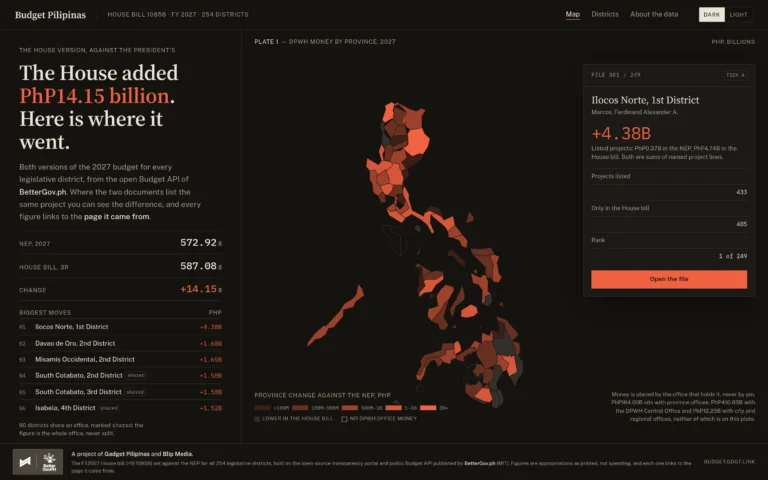
Gadget Pilipinas and Blip Media have published Budget Pilipinas, a free site that puts the President’s 2027 budget beside the version the House of Representatives voted on, for all 254 legislative districts. Every figure on it links to the page of the document it came from.
It is live now and needs no account. You type your district, or click it on the map, and the site shows what the National Expenditure Program gave it, what House Bill 10858 gives it, and the difference between the two.
What it actually answers
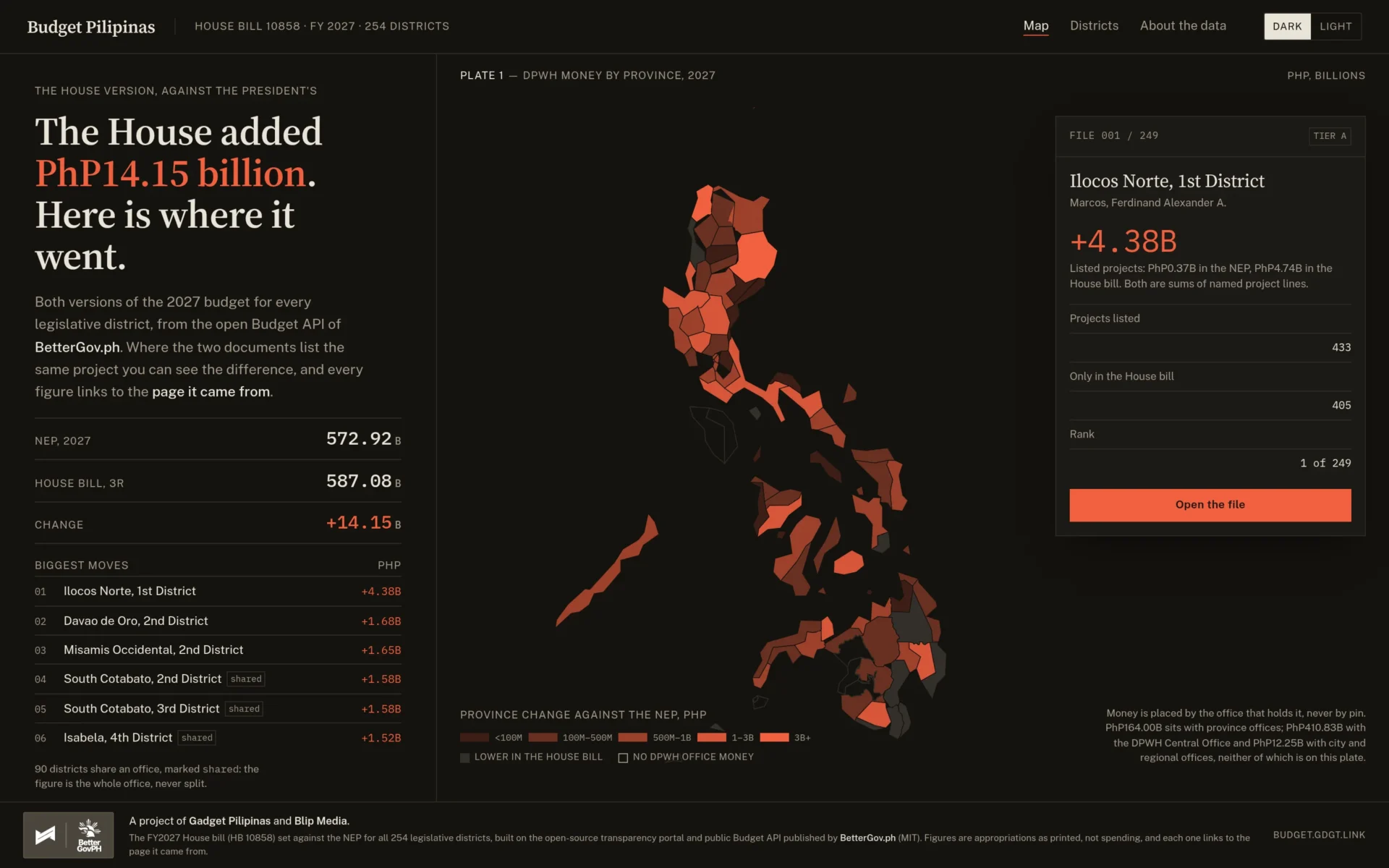
A district’s number on the site is not a summary written by us. It is the sum of the project lines that the two documents print under the offices serving that district. For the 2027 budget that is 17,613 lines of DPWH work: roads, bridges, flood control and buildings, listed project by project.
The site ranks all 254 districts by that change, so a reader can see where they sit without reading a bill. The map shades provinces, because the money is placed by DPWH office rather than by coordinates. Only 2,348 of those 17,613 lines carry a latitude and longitude, which is why the tool does not pretend to pin every project.
Three things it shows right away
One district stands far above the rest. Ilocos Norte’s 1st District goes from PhP0.37 billion in the NEP to PhP4.74 billion in the House bill, a change of PhP4.38 billion. Of the 433 lines listed for it, 405 appear only in the House bill. The largest single line is a PhP190 million bridge in Vintar, on page 464 of the third-reading document.
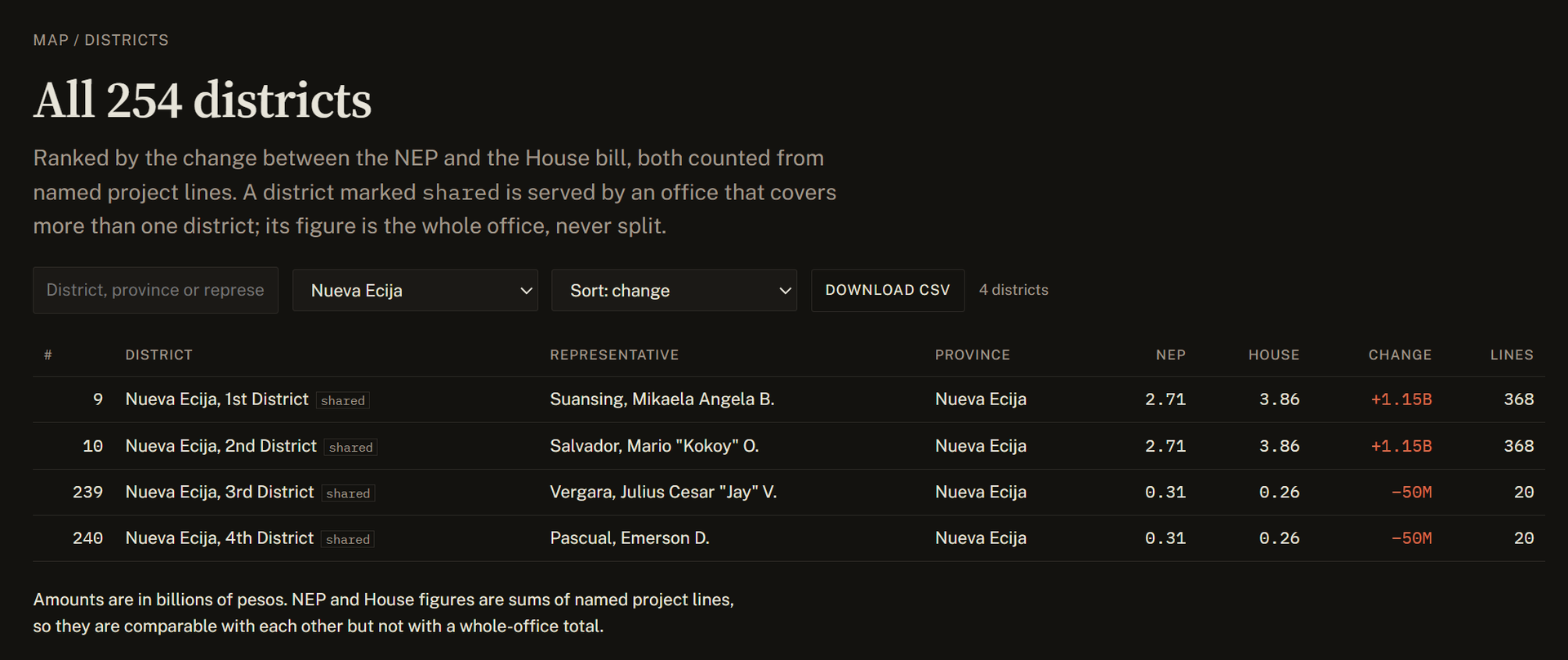
Ninety districts cannot be read alone. Their DPWH office serves more than one district, so the figure covers the neighbours too. The site shows those figures whole and marks them, because splitting an office’s budget between districts would invent a number that no document contains.
Five districts carry no money at all in this comparison. Lanao del Sur’s 1st and 2nd Districts, Maguindanao del Norte, Maguindanao del Sur and Tawi-Tawi have no DPWH office line anywhere in the 2027 comparison. A district missing from a national list is worth knowing about, so the site says so instead of showing zero.
One more number matters for anyone reading the map. Of the PhP587.08 billion in the House bill, PhP410.83 billion sits with the DPWH Central Office and cannot be placed by province. The site names that gap on the map and repeats it on the About page rather than quietly leaving it out.
What it does not claim
A line that appears in the House bill and not in the NEP is a candidate, not a confirmed insertion. A renamed project, a re-scoped project and a genuinely new project look identical from the outside, and the matching behind this data is done by name, place and amount. The site says “in the House bill only” and links the page. It does not say anyone inserted anything.
Amounts are appropriations as printed. They are the authority to spend, not spending, and not completion. The site repeats that on every page that carries a figure.
How it is built
The project is built on the transparency portal that BetterGov.ph published under the MIT licence, and reads their public Budget API. We kept their rules and their caution, and replaced the presentation with our own.
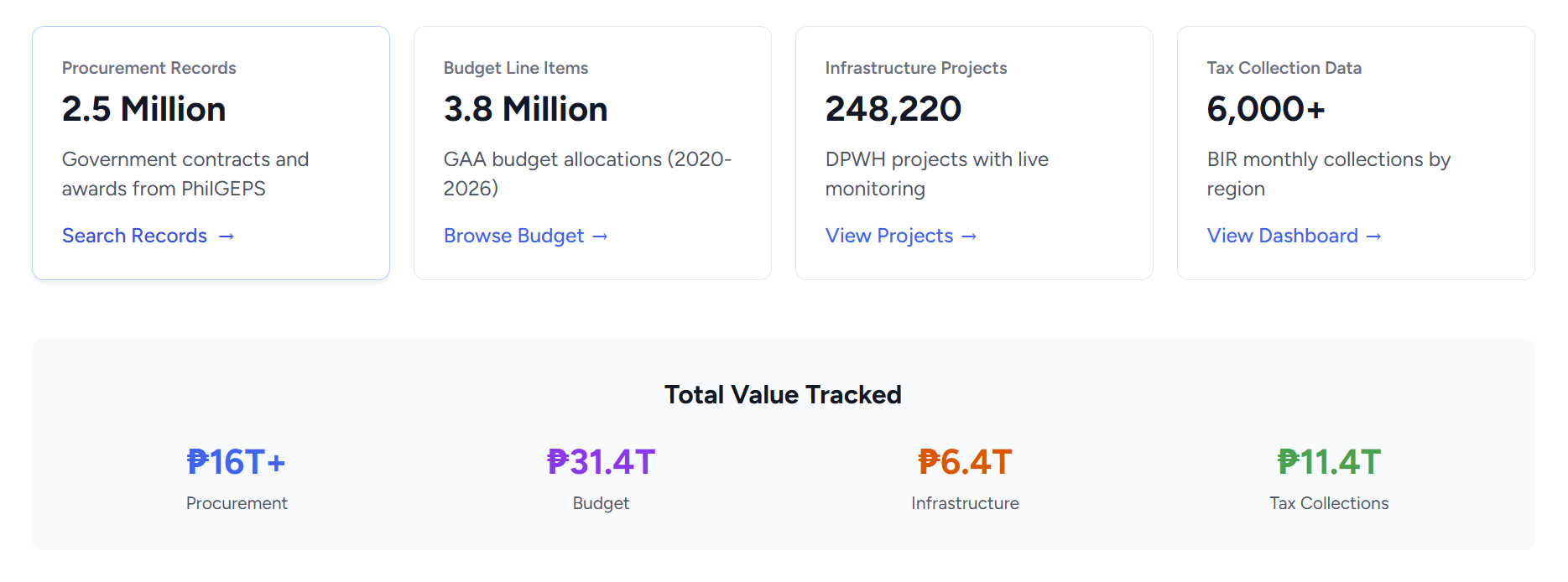
The result is a static site. There is no server, no database and no hosting bill, which means it stays up on its own and costs nothing to keep. A pipeline rebuilds the numbers from the API, and a set of checks refuses to publish if any total fails to reconcile. One of those checks is strict: the money placed by province, the money held by the central office and the money held by city and regional offices must add up to the national figure exactly, to the peso.
The district briefs on each page are written by a rule, not by a language model. Every number in a brief is re-derived from the data at build time, so a sentence cannot invent a figure.
What changed after launch
Within a day of publishing, a reader spotted an error, and it was a real one. Cagayan de Oro’s engineering offices had been placed in the province of Cagayan. The two names share the word “Cagayan”, and the matching stopped at that word. Cagayan de Oro is in Misamis Oriental.
The same fault had put Isabela City in the province of Isabela, when it is in Basilan, and Quezon City in Quezon province, when it is in Metro Manila. Three cities and four engineering offices, with money landing on the wrong island.
Placement now consults a short list of office names that mislead before it matches anything else, compares province names on whole words, folds accents, and handles the names DPWH prints in reverse order, so Mindoro Occidental lands in Occidental Mindoro. Every placement records the basis it was made on, curated or matched, and the About page explains the method.
A decision model now checks every placement
Rules like this fail quietly, which is worse than failing loudly. The pipeline now runs an audit after the rule and before anything is published. Jev, a decision model from TypeSafe AI served through OpenRouter, reads each of the 217 DPWH office names together with the region its projects actually sit in, and returns the map unit it would choose with a probability attached. It is not a language model writing sentences. A decision takes about half a second and costs a fraction of a cent.
The audit never changes a placement. Where Jev confidently disagrees with the rule, and the office is not already on the curated list, the build refuses to publish until someone records a decision. A disagreement becomes a task for a person, not a silent edit.
It found six offices the rule had dropped. The two Mindoro engineering offices, because the bill prints those province names backwards. Two combined Metro Manila districts, Malabon-Navotas and Las Piñas-Muntinlupa, worth PhP1.12 billion and PhP1.27 billion. The north and south Manila districts. And the NCR regional office.
It also flagged Southern Mindoro, where the name matches neither province and Jev was only 0.7 confident. That was the right answer to give, so we checked it by hand: the office’s projects are on Calapan South Road and in Bongabong, and coverage of the office datelines from Calapan City, Oriental Mindoro. It is placed there now, with the evidence recorded next to the entry.
On the map, placement rose from PhP168.90 billion to PhP174.84 billion of the PhP587.08 billion. Money the tool could not place fell from PhP7.35 billion to PhP1.41 billion. What remains is seventeen regional offices, each covering several provinces and belonging to no single shape, so they stay in the unplaced band and are listed by name on the About page.
It works on a phone now
The first version was built for a desktop screen, and it showed. On a phone the map sat below a long ranked list, and a project line could not be opened at all. The page now runs headline, figures, map, then ranking, so the map arrives in the first scroll. Ranking rows are 48 pixels tall and the whole row is the link, the district and project tables become lists on small screens, and the map measures its own container instead of assuming there is a panel beside it.
None of this changes what the site claims about the budget. Amounts are still appropriations as printed, a line that appears in one document only is still a candidate rather than a finding, and every figure still links to the page it came from. What changed is how carefully the money is placed before it is drawn.
Why we built it
Budget documents are public. The problem is that a province, a city or a district is buried hundreds of pages into a file that most readers will never open. A national dashboard that stops at the department level does not tell a reader whether the road in their town survived the House version.
Budget Pilipinas starts at the district because that is where a reader lives. If the tool is useful, it is because it answers a question that fits in one sentence: what happened to my district’s money?
The site is free, needs no account and carries no ads. Corrections are welcome: if a figure disagrees with the document, the document is right, and we will fix the snapshot.
Budget Pilipinas is a project of Gadget Pilipinas and Blip Media. Data and methodology come from BetterGov.ph’s open Budget API and its MIT-licensed transparency portal.

Gadget Pilipinas
Founded in 2009 by Gian Viterbo, Gadget Pilipinas is one of Philippines’ top sources for news, tutorials, reviews and tips about the latest trends in technology, gadgets, games, social and digital media and cyber culture.
View all articles →Related News




 TCL Shares the Perfect Films for its TVs