


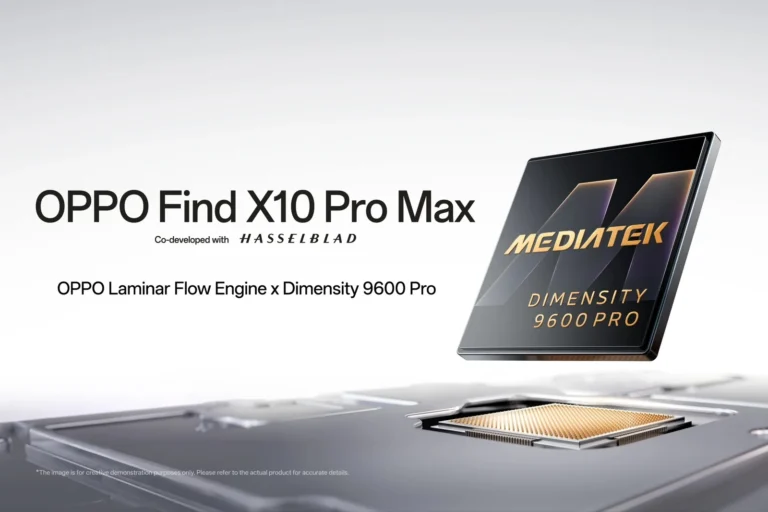
OPPO has confirmed that the OPPO Find X10 Pro Max will be among the first smartphones to ship with the flagship MediaTek Dimensity 9600 Pro when the device reaches international markets.
The announcement places the upcoming flagship on MediaTek’s newest top-tier platform, a chipset built on the TSMC 2nm N2P process node.
OPPO Find X10 Pro Max – MediaTek Dimensity 9600 Pro
OPPO says the move to 2nm brings up to a 61% improvement in CPU multi-core energy efficiency compared with the previous-generation process node.
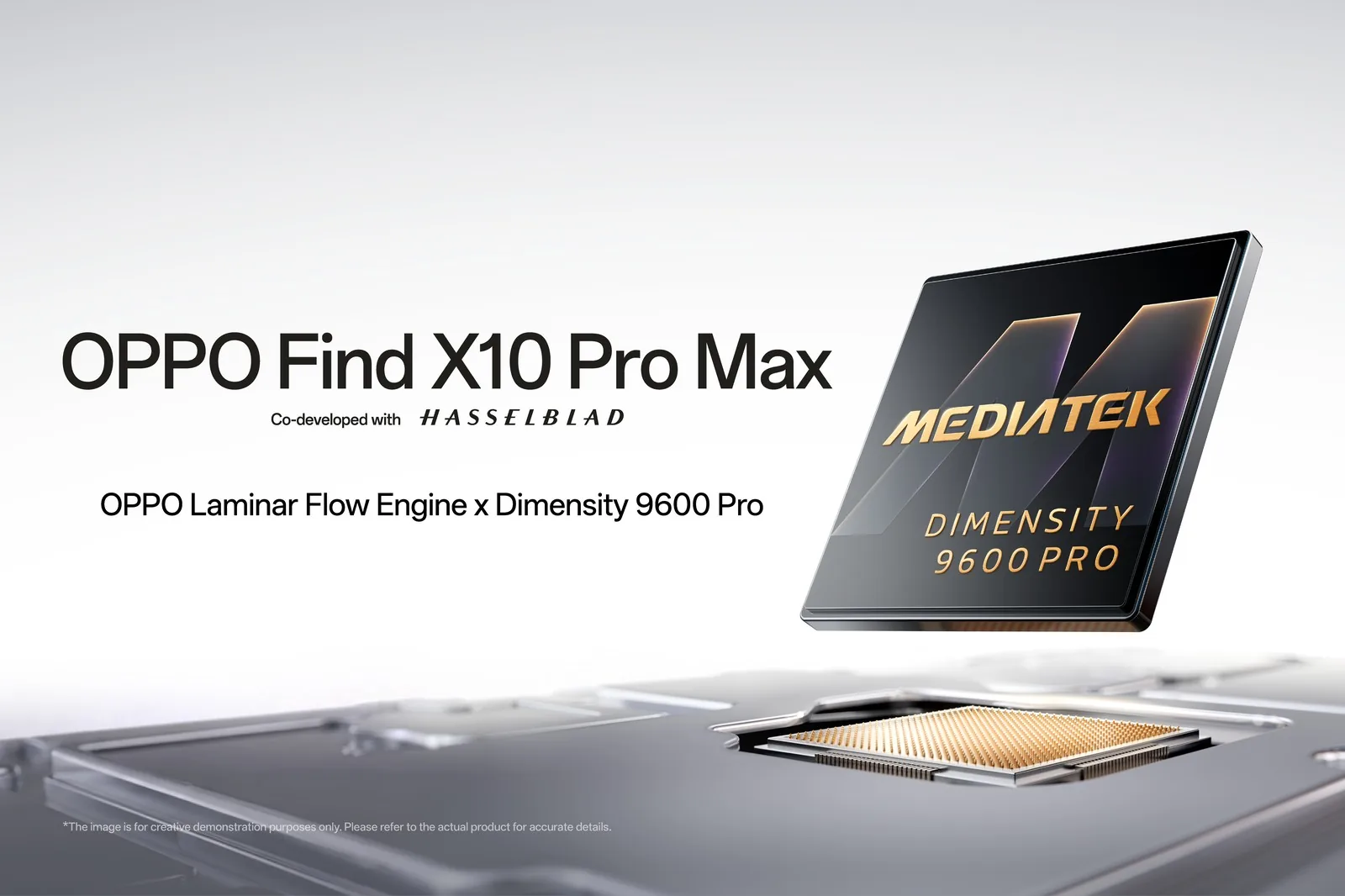
MediaTek describes the platform as a significant generational leap in both performance and power efficiency, and that claim rests on the newer manufacturing node.
What the OPPO Find X10 Pro Max Gains
That headroom is meant to support sustained flagship performance and the heavier on-device AI workloads that phones in this class are now expected to carry.
Under the hood, the Dimensity 9600 Pro continues MediaTek’s All-Big-Core architecture, built around two 4.55GHz C2-Ultra cores and six performance cores.
MediaTek rates the new CPU at a 17% overall performance improvement, with independent frequency control on each core for more precise workload scheduling.
The chipmaker says the goal is to maintain sustained performance while keeping power draw in check, a balance that matters more over long sessions than short benchmark runs.
Independent control per core also gives the scheduling layer more room to shift work around when one part of the load spikes.
Graphics and On-Device AI
Graphics performance moves to the latest flagship Arm G2-Ultra NX GPU, which adds enhanced ray tracing and new neural graphics capabilities to the platform.
Under sustained heavy workloads, the chipset delivers roughly 27% higher performance, which should translate to richer visual detail in demanding mobile games.
On the AI side, the Dimensity 9600 Pro adopts a latest-generation dual-NPU design that pairs a high-performance NPU with a Super Efficient NPU.
The main NPU is rated 51% faster at LLM prefill, supporting workloads that include large-model inference and computational imaging on the device itself. Meanwhile, the Super Efficient NPU is rated 40% more power efficient, allowing persistent AI features to run at ultra-low power for always-available experiences.
Together, the two accelerators are meant to cover both the heavy inference jobs and the lighter features that are expected to run in the background.
Computational imaging is a notable part of that, since camera processing is one of the heaviest sustained tasks flagship phones like the OPPO Find X10 Pro Max are asked to handle.
OPPO Laminar Flow Engine
OPPO and MediaTek also jointly developed the OPPO Laminar Flow Engine, which makes its debut on the OPPO Find X10 Pro Max.
The engine restructures the underlying rendering architecture and coordinates it more closely with system scheduling. It aims for a better balance between smooth responsiveness and low power consumption.
OPPO says it also helps accelerate app launches and keeps content loading smooth and stable in demanding scenarios such as rapid photo browsing.
Launch details still to come
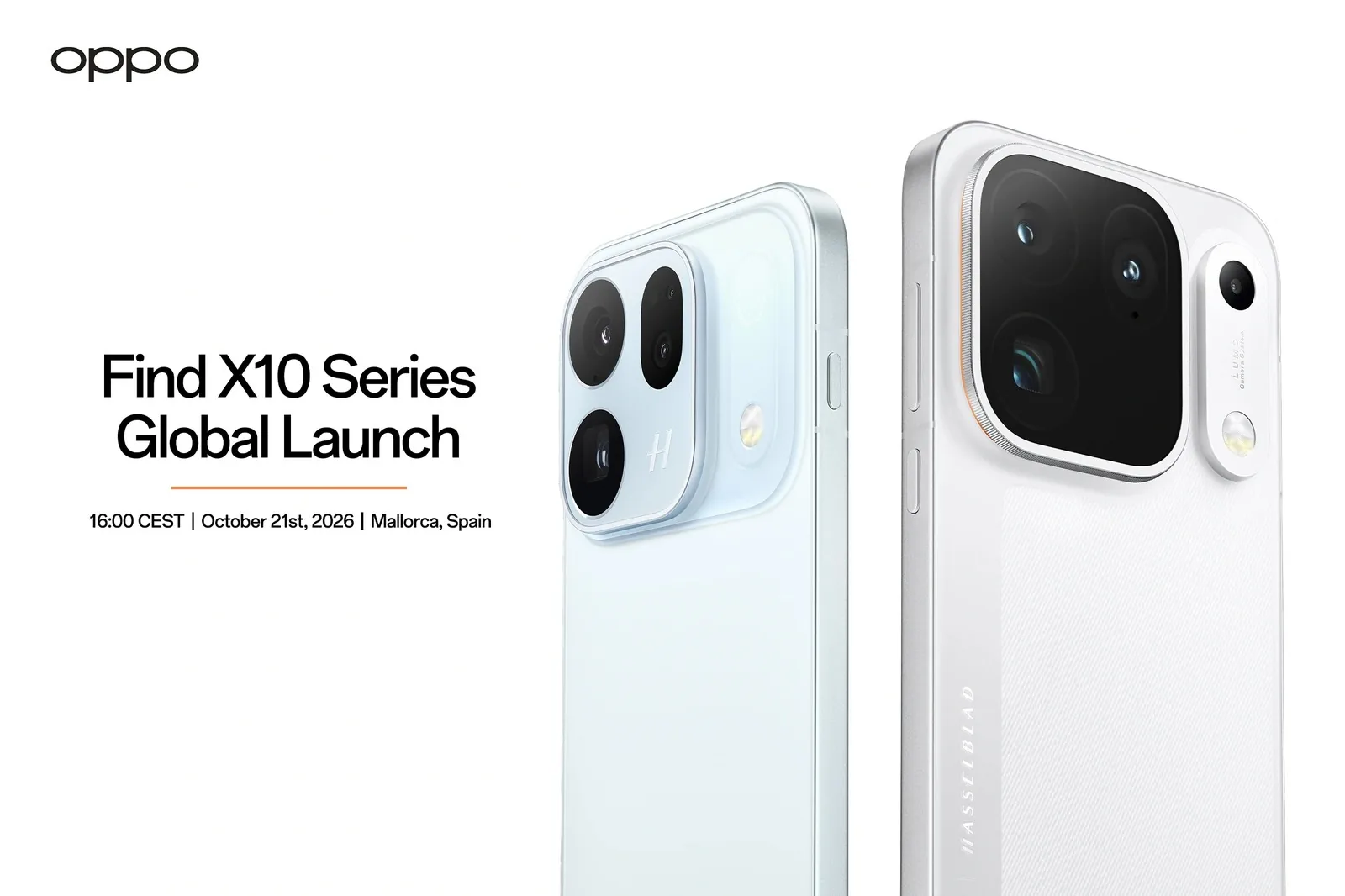
With the October 21 launch event in Mallorca, Spain, over the horizon, we expect to learn more about the OPPO Find X10 Series, including the OPPO Find X10 Pro Max, in the following days. However, the full specifications and pricing will surely be announced at the launch event itself.
MediaTek has been on a steady run this year, and the Dimensity 9600M takes many of the same flagship features down to more affordable devices.
The OPPO Find X10 Pro Max sits at the other end of that stick, and it seems like OPPO is leaning on the flagship silicon to sell it as a performance and efficiency upgrade rather than a camera story alone.

Ram Ronquillo
Ram found his love and appreciation for writing in 2015 having started in the gaming and esports sphere for GG Network. He would then transition to focus more on the world of tech which has also began his journey into learning more about this world. That said though, he still has the mentality of "as long as it works" for his personal gadgets.
View all articles →