

The Infinix GT 50 Pro is set to make its local debut soon as an esports-focused smartphone built to address one of mobile gaming’s biggest problems: heat. The device is a performance-first gaming phone, with its HydroFlow Liquid Cooling system being one of its key features.
HydroFlow Liquid Cooling
The Infinix GT 50 Pro uses an industry-first thermal management system. Instead of relying only on passive cooling, it has a dual-piezoelectric ceramic pump that actively circulates coolant through laser-engraved channels. The goal is to move heat away quickly from key internal parts such as the processor and battery.
This cooling architecture is designed to cover 100% of the hottest core components by building a large cooling layer directly with the main heat sink. This setup is meant to reduce thermal buildup at the source, limit performance throttling, and keep frame rates stable during demanding gameplay.
The phone also supports native 144FPS, helping deliver smoother motion and fewer drops or stutters in fast-paced matches.
Three Cooling Modes
The HydroFlow system offers three selectable modes for different situations. Smart Mode automatically adjusts flow velocity based on the scenario, balancing performance and efficiency. Normal Mode uses a lower flow velocity for standard heat dissipation during everyday use. Rapid Mode increases flow velocity for stronger cooling, making it better suited for heavier workloads and more intense gaming sessions.
For users who want even more thermal support, the Infinix GT 50 Pro can be paired with the GT Magcharge Cooler 2.0. This accessory combines cooling and charging through wireless bypass charging, which sends power directly into the phone’s system rather than constantly cycling through the battery.
Vapor Chamber Upgrade
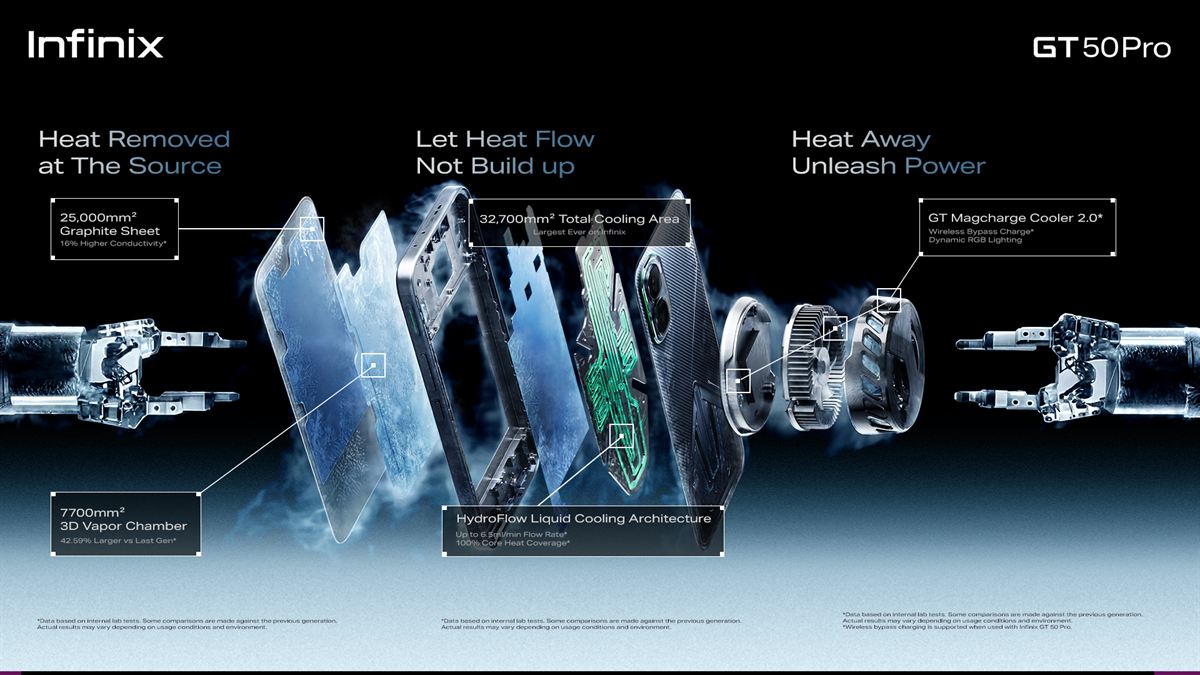
Apart from HydroFlow, the Infinix GT 50 Pro also features the largest 3D Vapor Chamber in GT history. The chamber measures 7,700mm², and the phone’s total cooling area reaches 32,700mm². Infinix says that total is 63.5% larger than the previous generation.
The larger cooling setup, paired with ultra-large graphite cooling layers, helps the phone remain stable during long gaming sessions, streaming, and multitasking. The overall promise is straightforward: better thermal control should lead to smoother performance from start to finish, especially when the device is under pressure.
Built for Competitive Play
The Infinix GT 50 Pro was engineered from the ground up for high-tier competitive gaming. The phone has also earned the distinction of being the official gaming phone of MPL PH, the Mobile Legends: Bang Bang Professional League Philippines. It has been chosen and trusted by the league’s top professional players for the stability, thermals, and sustained frame rates required in esports competition.
The Infinix GT 50 Pro officially launches on June 10. Ahead of that date, Infinix is offering nationwide offline pre-sale access from May 29 to June 10.
Customers who reserve their unit early can receive up to PHP 11,999 worth of freebies and discounts. For more details, visit official Infinix concept stores or kiosks, or follow Infinix’s official Facebook page, TikTok Shop, and website
Frequently Asked Questions (FAQ)
Q: What is the main highlight of the Infinix GT 50 Pro?
A: Its main highlight is the HydroFlow Liquid Cooling system, which is designed to keep the phone cool during heavy gaming.
Q: How does HydroFlow Liquid Cooling work?
A: It uses a dual-piezoelectric ceramic pump and laser-engraved channels to actively circulate coolant and dissipate heat.
Q: What cooling modes are available on the phone?
A: The phone has Smart Mode, Normal Mode, and Rapid Mode, each designed for different performance and cooling needs.
Q: Does the GT 50 Pro have additional cooling support?
A: Yes. It can pair with the GT Magcharge Cooler 2.0 for added cooling and charging support through wireless bypass charging.
Q: When does the GT 50 Pro launch?
A: The official launch is scheduled for June 10, with offline pre-sale activity running from May 29 to June 10.

Emman has been writing technical and feature articles since 2010. Prior to this, he became one of the instructors at Asia Pacific College in 2008, and eventually landed a job as Business Analyst and Technical Writer at Integrated Open Source Solutions for almost 3 years.