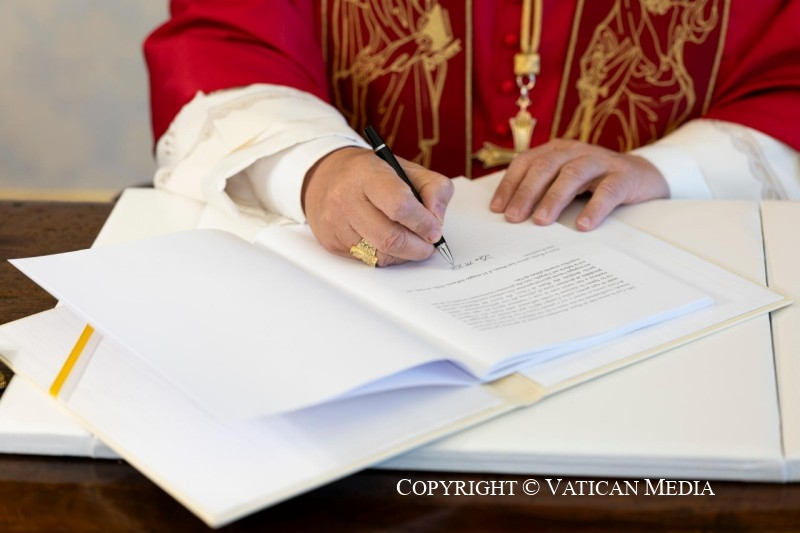
Magnifica Humanitas, Pope Leo XIV’s First Encyclical
Pope Leo XIV has released his first encyclical, Magnifica Humanitas, and it puts artificial intelligence at the center of one of the Vatican’s most significant social and moral debates in recent years.
Published on 15 May 2026, the document carries the subtitle “On Safeguarding the Human Person in the Time of Artificial Intelligence,” immediately signaling that this is not just a church text for Catholics, but a broader intervention into one of the biggest issues shaping politics, business, education, media, and daily life today.
A Parallel to Pope Leo XIII’s Rerum Novarum
At its core, Magnifica Humanitas argues that AI should not be treated as a neutral force that automatically leads to progress. Pope Leo XIV acknowledges that technology has helped improve human life across generations, but he also warns that today’s digital systems, including AI and robotics, now shape decision-making, influence public imagination, and concentrate power in ways that are harder to predict and regulate. That shift, according to the pope, makes the current moment different from earlier waves of innovation, because the issue is no longer just about using tools, but about how those tools are reshaping what it means to be human.
The document draws a parallel to Pope Leo XIII’s Rerum Novarum, the landmark 1891 encyclical that addressed labor, capital, and industrial society. Leo XIV says the Church cannot simply repeat old teachings word for word, because the “new things” of today involve digitalization, AI, and robotics, which are transforming the world at a rapid pace. In that sense, Magnifica Humanitas reads like an attempt to do for the AI era what Rerum Novarum did for the industrial age, by offering a framework for moral reflection, public discernment, and social responsibility.
The Babel and Jerusalem Symbolism
One of the strongest ideas in the encyclical is that the real question is not whether society should say yes or no to technology. Instead, Pope Leo XIV says humanity is choosing between two models of civilization, symbolized by the biblical stories of Babel and Jerusalem. Babel represents pride, control, uniformity, and a system that reduces people to efficiency and performance, while the rebuilding of Jerusalem represents shared responsibility, plurality, dialogue, and a vision of social life grounded in communion rather than domination.
That framing gives the encyclical an unexpectedly modern edge. Leo XIV points out that the people driving technological development today are often not governments, but private and transnational actors with enormous financial and technical power. That matters because it shifts the conversation away from abstract discussions about innovation and toward harder questions about governance, accountability, and whose interests are really being served as AI systems become more deeply embedded in everyday life.
The pope also pushes back against both extremes that tend to dominate AI discourse. He does not embrace a doom-heavy rejection of technology, but he also rejects the kind of techno-optimism that treats every new capability as automatic progress. Instead, he argues for what he calls shared discernment, along with regulatory tools, impact assessment, digital literacy, and a stronger commitment to protecting the most vulnerable as societies adapt to technological change.
The document includes dedicated sections on truth as a common good, truth and democracy, communication and the collective imagination, and what it calls an “ecology of communication.” Even from that structure alone, it is clear that Leo XIV sees AI not just as a productivity or automation story, but also as a media and information problem, one that affects how societies understand reality and how communities build trust.
Dignity of Work in a time of digital transition
Labor is another major pillar of the text. Magnifica Humanitas includes sections on the dignity of work in a time of digital transition, unemployment, and building an economy that values dignity. That puts the encyclical in direct conversation with contemporary fears around automation and job displacement, while also reinforcing the Vatican’s long-running position that economic systems should be judged by how they treat people and families, not simply by output, speed, or efficiency.
The encyclical goes even further by connecting AI to freedom, dependence, and commercialization. It warns about new forms of societal control and even speaks of “new forms of slavery,” suggesting that the Vatican is concerned not only with what AI can do, but also with how digital systems can shape habits, choices, and human agency over time. That concern makes the document relevant beyond church circles, especially in an era of algorithmic feeds, pervasive surveillance, and monetized attention.
Perhaps the most politically charged part of the encyclical is its final chapter, which links digital power to war, weapons, and the weakening of multilateral institutions. The text includes sections on the normalization of war, force without limits, weapons and artificial intelligence, and the crisis of multilateralism. In other words, Leo XIV is not treating AI as a narrow tech industry issue. He is placing it inside a much larger debate about peace, power, and the direction of global society.
What makes this new enyclical notable?
What makes Magnifica Humanitas especially notable is that it does not sound like a simple anti-tech manifesto. The pope repeatedly says technology can heal, connect, educate, and protect the common home, but he insists that none of those benefits excuse a model of development that sidelines the poor, erodes truth, weakens labor, or treats human limitations as flaws to be engineered away. His bottom-line argument is that progress must still be measured by the dignity of each person and the good of all peoples, not by scale, speed, or market dominance.
Key Ideas of the Encyclical at a glance:
| Theme | What Leo XIV argues |
|---|---|
| AI and technology | AI is a powerful human tool, but in practice it is morally shaped by those who control and use it, so it requires vigilance, governance, and moral discernment. |
| Human dignity | No machine can replace the grandeur of the human person revealed fully in Christ, and progress must be measured by the dignity of each person and the good of all peoples. |
| Social doctrine | Catholic social teaching is a living tradition for interpreting history, not a static set of concepts or a ready-made technical program. |
| Babel vs Jerusalem | Society must choose between domination, homogenization, and pride on one hand, or shared rebuilding, plural cooperation, and communion on the other. |
| Political economy | The pope warns that technological power is increasingly held by private transnational actors, which makes democratic governance and orientation to the common good more difficult. |
| Work and freedom | Digital transition threatens labor dignity and can create dependencies and new forms of control, so freedom must be protected socially as well as individually. |
| Peace | AI ethics must include war, weapons, diplomacy, multilateralism, and the perspective of victims, not just innovation policy. |
Read the full text of Magnifica Humanitas here.
Related:

Giancarlo Viterbo is a Filipino Technology Journalist, blogger and Editor of gadgetpilipinas.net, He is also a Geek, Dad and a Husband. He knows a lot about washing the dishes, doing some errands and following instructions from his boss on his day job. Follow him on twitter: @gianviterbo and @gadgetpilipinas.