


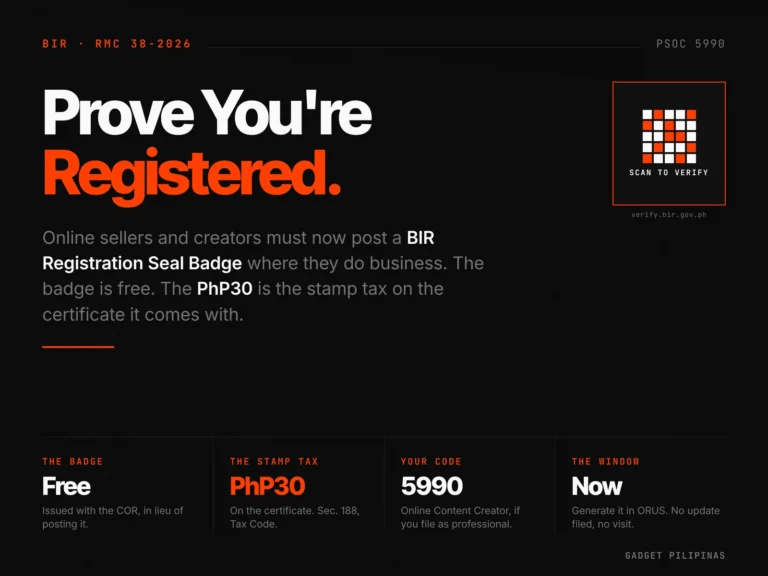
The Bureau of Internal Revenue now requires people who earn money online to display a digital BIR Registration Seal Badge on the platforms where they do business. The requirement lands hardest on creators, because it treats a vlog, a stream or a sponsored post as a storefront.
The rule comes from Revenue Memorandum Circular No. 38-2026, issued on 29 April 2026, implementing posting requirements that already existed in two 2024 revenue regulations. What is new is the form the proof takes. Instead of publishing your full Certificate of Registration, which carries your Taxpayer Identification Number and registered address, you post a compact BIR Registration Seal Badge carrying a QR code. A customer or brand can then verify you are registered without seeing any of that.
Who has to display it
The circular covers anyone in business or practising a profession online, and names the creator categories explicitly: bloggers, vloggers, live streamers, content creators and influencers, plus anyone earning through online views, ads, affiliate commissions or brand sponsorships.
Online sellers, e-commerce businesses, tutors and marketplace sellers are covered too. We have tracked the BIR closing in on this sector for years, including a reward scheme for reporting tax-evading influencers and a proposed withholding tax on online sellers. This circular is the enforcement mechanism those earlier moves lacked.

What the BIR Registration Seal Badge does
Scanning the code resolves to verify.bir.gov.ph, where a relying party can confirm the badge, the underlying certificate, and whether the registration is still active. Confirm that domain before trusting a scan, because a badge image is trivial to copy and the domain check is the only thing that makes it mean anything.
Step 1: get an ORUS account
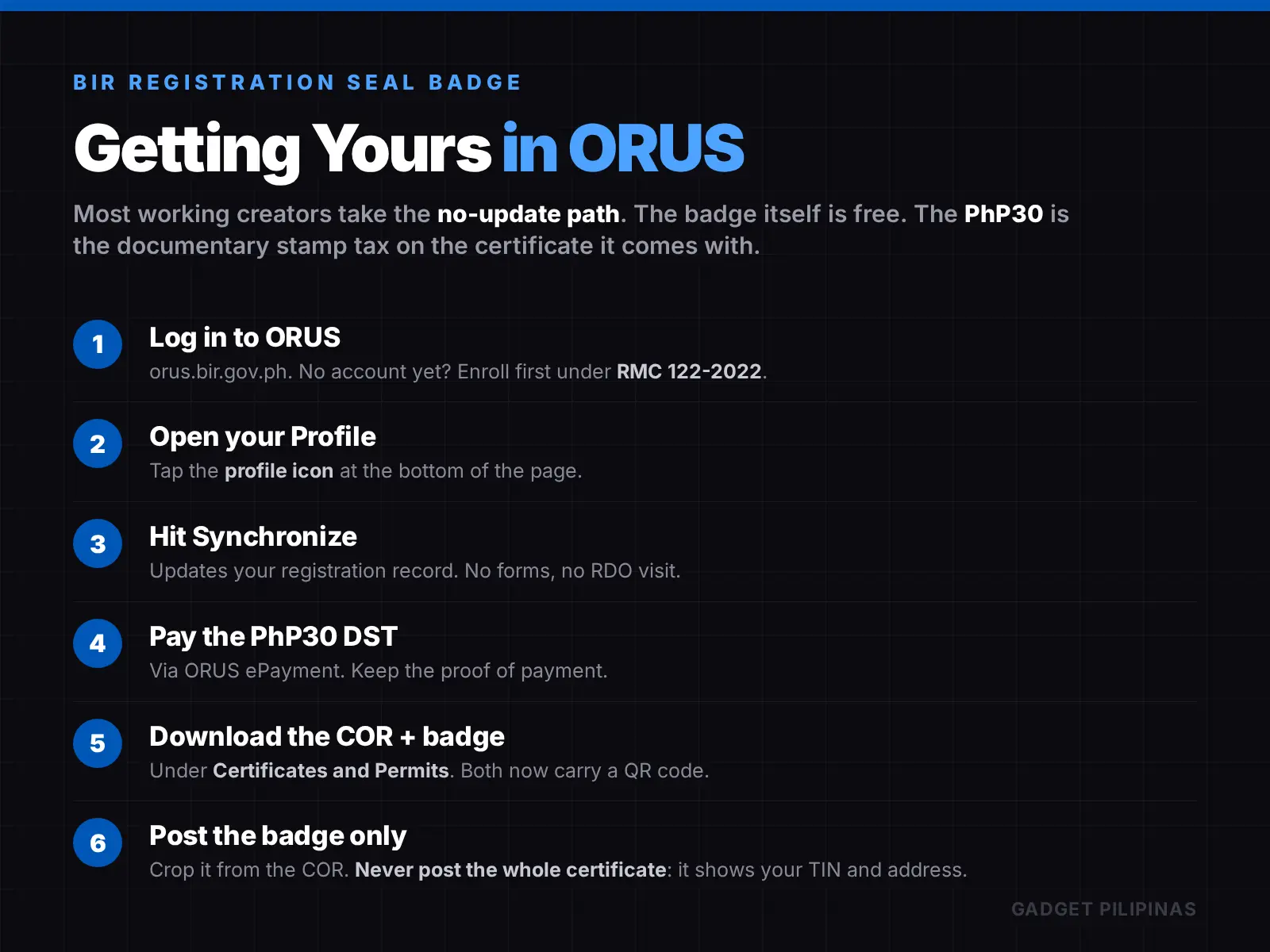
Everything runs through the Online Registration and Update System. Without an account, enroll under RMC No. 122-2022. One prerequisite catches people out: the email on your BIR record must be current, since ORUS verification checks it. If it has changed, file an S1905 update with your Revenue District Office first. (Download the S1905 here first). You will also be required to submit a board resolution if you operate as a corporation.

Step 2: take the path that matches your situation
There are three, and picking the wrong one is the usual way to lose a week. Registering for the first time, ORUS Annex C Section A walks you through BIR Form 1901 as an individual, including the industry screen where you pick your PSIC code. Already registered but needing a correction, use Annex C Section B, which runs through Update Information and a Correction, Change or Update of Registration.
Step 3: the no-update path, in full
Log in to ORUS, or create an account if you have not enrolled. Open your Profile page via the profile icon located at the bottom of the page, then click Synchronize to synchronise your registration record.
Then open the Certificates and Permits section, and download the latest Certificate of Registration with its QR code together with the Registration Seal Badge. The certificate is not issued until the documentary stamp tax is settled, so ORUS routes you to a payment channel before the download becomes available.
Step 4: the PhP30, and what it is actually for
This is the part most summaries get wrong. The circular states the badge is issued free of charge, and RMC 64-2026 adds that the PhP30.00 is payable when you generate the certificate.
Both are true because they describe different things. The PhP30 is not a fee for the badge, it is the loose Documentary Stamp Tax imposed under Section 188 of the Tax Code on the certificate and similar documents. The badge is issued with the certificate, so generating one means paying the tax on the other. You pay it through the e-payment channels ORUS offers, and you keep the proof of payment as part of your registration records. The Annual Registration Fee that used to accompany this was waived from January 2024, so this is the only amount most registrants will pay.
Step 5: post the badge, not the certificate
Only the badge goes online. You need not upload your full registration document or the page it appears on. Annex A shows the correct move, crop or scan the badge itself. Annex B warns plainly against posting the whole certificate because it will show your TIN and address.
Where it goes depends on the platform. On your own site or app, a visible page such as About, Company, Government Compliance or Business Permits. On a marketplace, your seller or merchant page or store details, somewhere a customer will see it.

The Philippines-specific catch for creators
If you are both a business and a professional, the circular sets out which code applies to which taxpayer. An individual registered as a professional is filed under PSOC 5990, Online Content Creator. Run a store as well and the retail codes apply: PSIC 47913 for retail sale via internet, 47911 for mail order, 47912 for telephone order, and PSIC 85593 for online tutorial services.
A creator who also sells merchandise would carry the professional code and the internet retail code on the same certificate. Check which of yours carries the badge before assuming one posting covers you. The monetisation we reported on as it expanded into the Philippines is exactly what this code is aimed at.
What has not changed
Two things have not changed. The badge replaces nothing physical: the certificate must still be displayed at your registered place of business, including branches and facilities, where the public can see it. The badge is the online proof only. A COR or eCOR without a QR code need not be replaced, though the circular encourages it, and covered taxpayers still need the badge.
What it means in practice
Two things follow. The badge becomes a buying signal: brands and agencies can confirm a creator’s registration in one scan, which cuts both ways for anyone who has treated sponsorship income as informal. And the requirement is about visibility rather than collection, as the BIR framed it, making legitimate sellers accountable from the start.
There is no new tax and no new registration here. What is new is that the proof now has to be public, and creators have a smaller, safer thing to publish than the certificate they were previously told to post.
Sources: RMC No. 38-2026 (full text, PDF) · RMC No. 64-2026 · BIR ORUS

Giancarlo Viterbo
Giancarlo Viterbo is a Filipino Technology Journalist, blogger and Editor of gadgetpilipinas.net, He is also a Geek, Dad and a Husband. He knows a lot about washing the dishes, doing some errands and following instructions from his boss on his day job. Follow him on twitter: @gianviterbo and @gadgetpilipinas.
View all articles →Related News

 Smart iPhone 18 Pre-Orders Open on Plans+ 1499
 The OPPO 10.10 Sale Starts October 3